Showing posts with label photography. Show all posts

2011-11-29

Realism vs. idealism in depictions of women

Venus von Willendorf
Photo: Matthias Kabel
People have long held a fascination with the human—and in particular, female—form. Some of the earliest cave paintings from tens of thousands of years ago include depictions of women. Throughout human history, artistic depictions of the female form have reflected the ideals and longings of the cultures that created them. Both instinct and culture are important to shaping these preferences, and concepts of beauty definitely change over time.

Depictions of women often depart from faithful representation of the female form. Venus figurines dating back thousands of years exaggerate some features like hips, breasts, or genitals. By choosing to emphasize these parts of female anatomy, perhaps the artists hoped to express their awe at women’s power to create and nurture life.

Artists are limited by the medium in which they work, the technology available, and their own knowledge and skill. As the state of the art has evolved, so has the faithfulness with which artists have portrayed the world. What has not changed though is that artists exaggerate.  The media and the tools may be different today than when the Venus von Willendorf was carved some 22,000 years ago; but the basic principle is the same: start from images of actual women, and create an idealized image of femininity.

Michelle Merkin
Modern glamour photography takes this process to its logical conclusion. Starting with already fit models, photographers and graphic artists tweak, enhance, add and remove, until the desired image of perfection has been achieved. It should come as no surprise that the resulting images are striking, and effective at capturing the attention of readers (and the dollars of advertisers). Perhaps in part because the images are exaggerated, they are arresting.

The practice of enhancing photos of women has become so widespread though, that it has led to a fair amount of criticism. Feminist pundits worry that unrealistic images of women contribute to an atmosphere in which women are held to an unattainable standard of beauty. The argument goes that the prevalence of images of beautiful women makes women feel bad about their appearance, and makes men expect above-average attractiveness in women. It has been shown that the images to which people are exposed do indeed affect their attitudes and behaviors, so perhaps this is not an entirely unfair critique.

Some have suggested one possible remedy: that a warning label be required on all images that have been doctored. It’s hard to imagine this happening though. Most images created today are enhanced in one way or another. Moreover, there is no obvious place to draw the line between unadulterated and enhanced imagery.

 
Lizzie Miller
Photo: Walter Chin/Glamour
Other feminist thinkers have argued for more diversity in the portrayal of women. Glamour magazine recently published a photo of model Lizzie Miller, who, although attractive, is somewhat fatter than the typical photo model. The photo elicited considerable feedback from readers, most of it positive. A common theme emerged in the reaction to the photo: there should be more photos in the media of average women.

Unfortunately though, this is not a solution. What is average? In the United States and a growing number of countries in Europe, a significant portion of the population is overweight. If depictions of women were based on the average, this example would be an unhealthy one to follow! Most people would be healthier and live longer if they ate less and exercised more. Body acceptance is a great, but not when it facilitates an unhealthy lifestyle.

It’s a good idea to increase the diversity of body types depicted in media—but centered around a healthy body, not an average one.

2009-09-28

New lighting equipment


The photo shoot with Hannah reminded me how much fun it is to take photos in a studio setting. When one has greater control over the light, one can do so many fun things that just aren’t possible otherwise. Inspired by this experience, I began to think about putting together my own portable studio—a set of lighting gear I could set up at home or on location. Robban, the chap who lent me his studio in Stockholm during the summer, gave me some good recommendations, and I put together a list of the equipment I would need.
Today I placed an order for my starter kit:
Obviously I’ll need to find a place to work. I think the living room at home would be a good place.

I’m going to investigate options for setting up larger backgrounds than the collapsible ones I’ve ordered. Plain black or white cloth would probably suffice for many applications I have in mind; then I just need a rig to hold it in place. If anyone has suggestions for flexible and inexpensive ways to set up backgrounds, please get in touch.

Another thing I’d like to do is to find a way to block stray light from the windows, so that I can work during the daytime. It’s too bad this house wasn’t constructed after the built-in rolling shutters became popular in this part of the world—those things are great for blocking out light! Perhaps some heavy curtains would be a good solution. They could remain in place even when not in use. However, maybe there are other ways to block the light. I welcome ideas on this too.

Most of the new gear should arrive within a couple of days. I’m excited about putting it to use for the first time!

Advice for new DSLR owners

I had a long chat last night with my friend Annelie in Stockholm, who recently purchased her first digital SLR—a Canon 1000D with an 18-55 f/3.5-5.6 kit lens. She was frustrated with the results from her first day of shooting. After a bit of questioning, I learned why: she had taken a bunch of photos using settings chosen essentially at random.

I gave her three pieces of advice:
1. Learn the language and basic principles of photography. Learn how ISO, aperture, and shutter speed affect the amount of light collected. Learn how the aperture affects depth-of-field.
2. Learn the capabilities and limitations of your camera and lens. Learn about the main modes of your camera, and start taking photos in aperture priority mode (A on Nikon, Av on Canon).
3. Get a 50mm f/1.4 lens, and start playing with it. Shoot in aperture priority mode, but also start experimenting with manual mode, particularly in low light settings.

My 50mm f/1.4 lens is my favorite lens by far because of the freedom its wide maximum aperture and light weight afford. I often go out with only my 50. I have learned more about photography while using my 50mm f/1.4 lens than with any other lens. I’ve also taken many of my best photos with this lens. It’s so simple and so fun to use.

I’m looking forward to seeing the results of Annelie’s next photo session.

2009-09-23

Helena in the studio


_MAL8017.jpg, originally uploaded by Michael A. Lowry.

My good friend Helena Petterson saw my photos of Hannah this morning and gave me some positive feedback. Helena is also a photographer, and so we talked for a while about poses, techniques and ideas for future photo projects. It was then that I remembered the shoot we did together last year. Here are some photos of Helena I took in a studio in Stockholm, just before I moved to Switzerland.

2009-09-22

Hannah in the studio


_MAL3794, originally uploaded by Michael A. Lowry.

When I was in Stockholm in July, I spent a rainy afternoon hanging out with my good friend Hannah. On the spur of the moment, I picked up my camera and captured a few remarkable photos of her. Impressed with her natural beauty and ease in front of the camera, I invited her to do a photo shoot with me a couple of days later. We spent a Friday afternoon in a lovely villa on Gärdet. We set up a studio in one large room, but also took photos at other locations in the house. We had a terrific time, joking, laughing, and capturing some amazing photographs. I’m very pleased now to share some of the best photos of Hannah.

2008-05-05

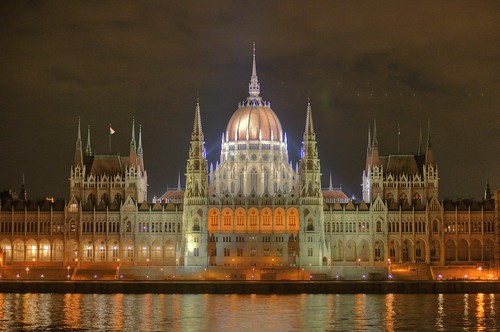
Hungarian Parliament building in Budapest


_MAL3957.jpg, originally uploaded by Michael A. Lowry.

In photography, taking several different exposures of the same scene, each with slightly different settings is called bracketing. in the days of film, photographers often used bracketing when they weren’t certain of the correct exposure or aperture. By bracketing (capturing a few photos with settings in each direction below and above the current settings), a photographer could increase the chances that at least one photo would have the desired exposure, depth-of-field, or whatever else he was looking for. Bracketing is also a useful tool in teaching the art of photography: having several photos of the same scene taken with different apertures, say, helps one to understand the effect the aperture has on the final photograph.

Nowadays, the bracketing feature built into many cameras can be used for some cool new techniques that were not possible a few years ago. With the help of software, it is now possible to combine multiple photographs into a single photo that contains more information than any one of the original images.

Two techniques that fit this description are focus stacking and high dynamic range imaging. Focus stacking involves combining several photos taken with different focal points into one photograph that has a greater depth-of-field than any of its constituent photos. The advantage of this is that the aperture can be left relatively wide. This lets the photographer shoot with shorter shutter times and reduces refraction artifacts often introduced by tiny apertures.

I haven’t yet tried focus stacking. But today I made my first attempt at high dynamic range imaging. The result is the image above.

While in Budapest on business last month, I took a bunch of photos. I haven’t had time to go through most of them yet, but this morning I took a moment to take a look at some of the photos I took of the Hungarian Parliament building across the river from my hotel. I set the camera to take a decent middle-of-the-road exposure. Normally, this photograph would have been quite okay; but it would not have been perfect. The problem with this kind of scene is the big difference in brightness between the darkest and the brightest parts of the image. A photo that properly exposes the brightly illuminated dome would be far too dark to reveal the details of the building’s wings; and a photo with a long enough exposure to capture these details would be blown out in the bright parts.

So I took five of different exposures of the same scene, each with a slightly different shutter speeds: [-2, -1, 0, +1, +2]. I rested the camera on a flat railing and started the exposures using a timer, to ensure that the five photos were of exactly the same scene. The software essentially combined the best-exposed portions of each of the images, resulting in a single image that appears perfectly exposed across the dynamic range. Obviously, the full range of luminosities of the original scene is not represented exactly the same in this image. The original colors have been reassigned to a different palette displayable on standard computer displays, using a technique called tone mapping.

I'm pleased with the result and plan to take more similar photos soon.

2008-04-23

Budapest notes

I'm in Budapest for a week of technical courses related to the Tivoli software I work with in my new role at IBM Software Group. So far, so good. This morning I'm going through a bunch of hands-on labs that show the new features in the most recent releases of IBM's enterprise monitoring tools.

Budapest is beautiful. The weather reminds me of Texas: it was sunny and warm the first day, we had a thunderstorm that night, rain yesterday, and it's hazy and humid today. Last night I joined some Swedish and Norwegian colleagues for dinner at a traditional Hungarian restaurant on the Pest side of the Danube (the hotel is on the Buda side). After dinner, I walked a few blocks to a restaurant/night club where I had read there was supposed to be salsa dancing every Tuesday evening. Unfortunately, I was misinformed. The dancing is only on Fridays and Saturdays. So instead of dancing, I took a long walk along the river and took some photos of famous bridges and buildings. I tried out my D300's bracketing feature for the first time, taking several exposures of exactly the same scene, but with slightly different shutter speeds. I intend to combine the photos in the computer, taking the best-exposed portions of each photo. The result should be a single photograph with "high dynamic range." HDR is a relatively new set of techniques. Do a search on flickr for photos tagged with 'hdr' and you'll get an idea of what's possible. The result can be quite dramatic.

My colleague and friend Warren is here from Austin to give several talks related to IBM's workload automation products. Tonight we plan to find a brewpub and sample some of the local beers. If there's time, I might also take a dip in the Széchenyi fürdő (thermal bath) here. I went to that bath with my good friend Agnès when the two of us traveled around Eastern Europe together nearly sixteen years ago. I remember that the Hungarians had an amazing tolerance for heat. They sat unperturbed on the top bench in a sauna whose lower bench proved too hot for me. I also remember that bath as the place where I was treated to the best massage of my life. Not the sexiest massage, mind you—my masseur was a very large and very brusque Hungarian man. But it was the best massage. Afterward, I felt like a piece of cooked pasta.

I'll return to Stockholm Friday night. Saturday, I'll attend the wedding of my friends Sarah and Thomas. I'll also be tasked with taking photos at the wedding, so I'm excited about that.

2008-01-30

Flickr EXIF Search, Part 2

I’ve done a bit of experimentation and learned a few more keywords one can use to search for photos in flickr by their EXIF data. I have also gleaned the pattern that seems to have been used for coming up with the keywords. They appear to be abbreviations.

KeywordMeaningAbbreviation forUnit
xelminimum exposureEXIF exposure lower limitseconds
xehmaximum exposureEXIF exposure higher limitseconds
xflminimum focal lengthEXIF focal length lower limitmilimeters
xfhmaximum focal lengthEXIF focal length higher limitmilimeters
xalminimum apertureEXIF aperture lower limit
f-number
xahmaximum apertureEXIF aperture higher limitf-number

Perhaps there’s a way to specify an exact exposure, focal length, or aperture without having to use both the lower and higher limit keywords together. If so, I haven’t found it yet.

I also haven’t yet figured out how to specify fractional exposure times (shutter speeds of less than one second). It seems to treat all decimal values less than 1 as simply 0. The text displayed above search results is not always correct. For example, when one uses xel or xeh to search for photos taken with fractional exposure times (shutter speeds of less than 1 second), the text displayed above the search results incorrectly rounds the fractional exposure times down to 0. Similarly, when one performs a search using xfl or xfh independently, the wording displayed above the search results does not correctly reflect the way these keywords function. The words shorter and longer are interposed.

Obviously, not all of the kinks have been worked out. Maybe that’s why these keywords remain undocumented. I have started a discussion thread about this in the flickr ideas group.

2008-01-29

Flickr EXIF Search


Flickr EXIF Search, originally uploaded by blech.

Recently, I have begun to tag each of my photos with information about the camera and lens used to take the photo. It’s easy to add another tag to a batch when I’m uploading new photos. However, it’s a bit more time-consuming to go through my old photos on flickr and determine which photos were take with which lens.

Then I had a thought: the camera model used to take a photo is encoded in the photo’s EXIF data; so are the focal length, shutter speed, and aperture. The specific lens used is not included in the EXIF data, as far as I know. But using the information that is is there, it ought to be possible, I thought, to locate all the photos that were taken with a particular lens.

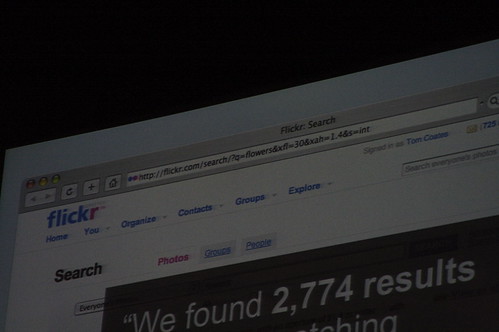
This led me to search for a way to locate photos on flickr based on their EXIF data. Amazingly, there's very little information out there about how to do this. I did find this one photo though, and in it one can clearly see two search parameters that don’t seem to be publicly documented by flickr:

  • xfl — the maximum focal length; find photos with this focal length and shorter;
  • xah — the minimum aperture (maximum f-number); find photos with this aperture and wider (this f-number and smaller).

Using these parameters, it's possible, for example, to perform the following search:
Find all of my photos tagged with climbing, with an aperture of f/2.7 or wider, and with a focal length of 50mm or shorter.

I have only one lens faster than f/2.8: my 50mm f/1.4 prime lens. So any photos returned by this search must have been taken using this lens.

Does anyone know if these and other EXIF-related search parameters are documented anywhere? I'd really like to learn more about how to perform searches using EXIF data.

Also, I would really like to know how to perform batch operations on the search results. Is there a way to add all of the results of a search to a batch in the flickr organizer? If not, there ought to be.

2008-01-20

Always check the camera settings first

I had been wondering why many of my photos had a reddish or yellowish cast lately. I’m using a new camera, so I figured that it just worked differently. I adjusted the photos after the fact in Adobe Lightroom and got pretty good results. Then tonight I was taking some indoor shots in low light and the photos were just unreasonably red. Yeah, there was some red light in the club where I was dancing, but not that much red light. So I finally started fiddling with the camera to see what was wrong. Of course, it was the most obvious thing: the white balance was set to a preset value instead of to automatic. How it got set that way, I don't know. To be honest, I don’t even know how long it’s been like that.

Well, the very first photo I took after setting the white balance to automatic was simply amazing. Not only was the color spot-on perfect, but the camera picked up light and color that simply weren’t visible to the naked eye. Despite having been taken in a poorly lit nightclub, the photo looked like it had been taken during daytime at a café or restaurant. Of course I took a bunch more photos once I got the settings right!

The silly thing is that I took dozens of photos before bothering to check the settings. Yeah, they can be fixed in the computer, but it requires a bit of guesswork and the results are often inconsistent. Next time, I must remember to check the settings before I start taking pictures.

2008-01-14

Six of my photos published on steelydan.com


_MAL1615.jpg, originally uploaded by Michael A. Lowry.

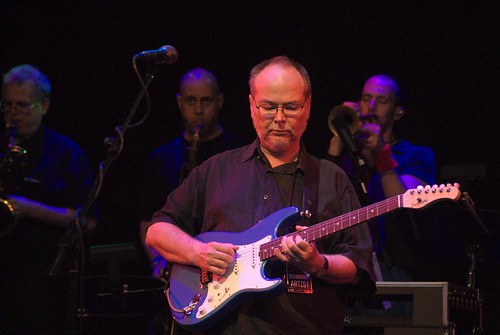
A colleague and fellow Steely Dan fan brought this to my attention. The webmasters at steelydan.com have added some of my photos to their collection of photos from the band's Heavy Rollers 2007 tour. I counted a total of six of my photos there.

In return for allowing the band to use my photos, I got a promise of a VIP pass to their next concert in Stockholm. Here's hoping it happens soon!

2007-12-07

Nikkor 14-24mm f/2.8 zoom lens


_MAL0016.jpg, originally uploaded by Michael A. Lowry.

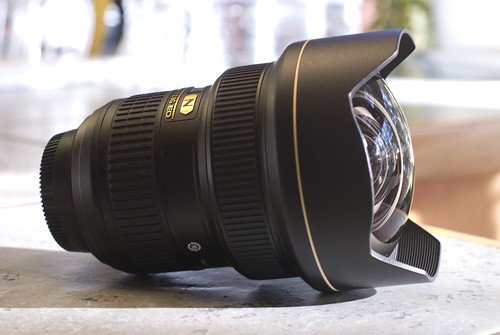
Here is the most recent addition to my camera bag, a Zoom-Nikkor 14-24mm f/2.8 lens. This is my first ultra-wide zoom lens, and after just a month on the market, it's getting rave reviews, besting most other ultra-wide zoom lenses on the market and matching or surpassing many wide-angle prime lenses.

The lens is a monster. It weighs a kilogram and the bulbous end of the lens protrudes quite a bit, especially when zoomed out to shorter focal lengths. I’m going to have to be extra careful with this baby to ensure that the glas does not get scratched.

I've taken a few shots with the lens and I'm very pleased with the results so far.

2007-09-05

Nifty novelties from Nikon in November

Last week, Nikon announced the impressive new D3 digital SLR camera. The D3 is Nikon's first foray into the full-frame DSLR market, with a new 35mm CMOS sensor developed in-house at Nikon. Previous Nikon DSLRs have incorporated Sony sensors. The 35mm sensor yields an effective 12.1 million pixels.

The camera also sports Nikon's new EXPEED digital image processing system, another technology apparently developed in-house at Nikon. As I understand it, this is Nikon's answer to Canon's DIGIC digital image processor.

The D3's strengths seem to be speed and low light sensitivity. It can capture 9 frames per second in full resolution and can capture images at an ISO equivalent of up to 25,600.

The superb photo equipment review site dpreview.com has a preview of the D3. The camera is estimated to have a retail price of 5000 USD when it arrives in November, putting it beyond my current means. I'm only an amateur photographer after all (I'll gladly accept donations though, so if anyone wants to finance my dream of owning a D3, please let me know!).

However, the new AF-S NIKKOR 14-24mm f/2.8G will sell for a slightly-more-reasonable 1800 USD, and just might end up on my shopping list when I'm in the U.S. later this year.

This is the lens I've been wishing Nikon would make ever since I bought the D200 a year and a half ago.
Unlike the plastic 12-24 f/4, this new lens is made of metal and has the same build quality of Nikon's other professional lenses (such as the 70-200 f/2.8). It's also one f-stop faster, with a maximum aperture of f/2.8 throughout the whole zoom range. Lastly, it's a full frame lens, not a DX lens; so it will work on the D3 and subsequent full frame cameras from Nikon.

By the way, Nikon is calling the full frame format of the D3 "FX" to distinguish it from 1.5 crop factor "DX" format of all of Nikon's previous DSLRs.

Along with the D3 and the 14-24 lens,
Nikon also announced a new 24-70 f/2.8 lens and the three new telephoto lenses, all of which sport Nikon's new nano crystal coat to reduce interior reflections. Incidentally, Nikon also announced the D300, the worthy successor to the D200. It will sell for the current price of the D200, and Nikon seems to plan to market the two cameras simultaneously; so no doubt the D200 will see a drop in price when the D300 arrives in November. The D300 looks like a very nice camera; but it doesn't represent a large enough improvement over the D200 to justify shelling out nearly two grand for the ugprade. I've only had my D200 for 18 months, and I am hoping it has a few more years of life left in it.

Speaking of that, I took my great little 18-200 VR zoom lens to the Nikon office here in Stockholm yesterday because the mounting ring for filters and the lens hood had come loose. A very helpful technician named Torbjörn fixed the lens while I waited. Unfortunately, there was a small problem: the ring was not put back on correctly. When I attached the lens hood, it wasn't aligned with the camera, so portions of the hood were visible at the near end of the zoom range. I took the lens back to Nikon today and Torbjörn quickly fixed the problem. To compensate me for my trouble, he also replaced the rubber on the grip of the camera free of charge. That's excellent customer service. With the new rubber on the grip, the camera looks almost brand new again.

Now if only I had remembered that my 18-200 lens was still under warranty! I bought the camera back in June of 2006, and I must have had this date in my head when I took the lens in for repair. I forget that I didn't get the lens until last November. So yes, it's still covered by Nikon's one-year worldwide warranty. I'll call Nikon tomorrow and see if they'll be willing to refund the cost of the repair. It was just 500 SEK, sure; but if I'm going to shell out 1700 USD for the new 14-24 lens, I have to save my nickels and dimes wherever I can.

2007-03-27

New photo set: Portraits

I have begun to reorganize my photo sets, taking advantage of the new “collections” feature in flickr, and grouping most of my photo sets into collections based on kind or content.

My most recent change is the addition of a photo collection for artistic photos — in other words, photos that have more artistic than informational value, and I hope are appealing as more than mere what's-Michael-been-up-to reportage.

Portraits is a new set in this collection. I think some of them are quite good, but I'll let you judge for yourself.

My next task it to go back through the set and remove photos that are either not strictly portraits in the classic sense of the word, are are simply uninspiring. My intention for the sets in the artistic collection is that these sets contain only aesthetically pleasing photos.

2007-02-26

Bus accident


_MAL0393, originally uploaded by Michael A. Lowry.

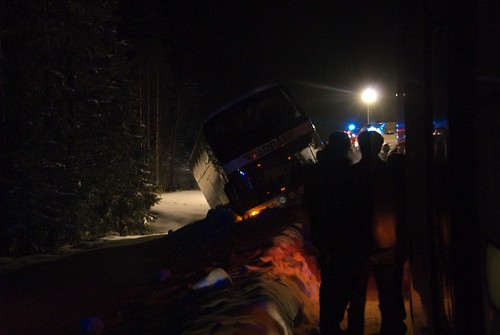
On the ride back to Stockholm from Kittelfäll last night, our bus went off the road.

The accident was not terribly dramatic. The bus lost power and slid to a stop in the ditch beside the road. The bus was leaning about 26° but it did not topple over. We evacuated calmly and assembled outside. No one was injured.

The emergency services folks gave us a ride on a local commuter bus to the Viksjö Folkets Hus (community center), where we stayed for the next several hours. During that time, we were provided with hot & cold drinks and sandwiches. After 04.00, a replacement bus arrived. Our bus was successfully pulled out of the ditch by towtruck, and as far as I know drove to Viksjö under its own power. We moved our luggage from the original bus and completed our trip to Stockholm on the replacement bus. We arrived about 4 hours later that originally planned.

I would like to extend my thanks to the emergency services personnel who came so quickly, gave us a warm place to stay, and who did everything they could to make us feel welcome. Thanks also to the staff of Active Ski Travel, who handled the situtation professionally, and even gave us gift certificates for our next trip with them.

I captured several photos during the eventful night. The accident has also been reported in Aftonbladet and Expressen. I'll post more photos from the trip (including some actual ski photos) soon!

Update 2007-02-26 15:41 UCTExpressen published my photo along with a slightly hyped-up article. The bus was not near a cliff or drop-off. It slid most of the way down a 2-meter deep ditch beside the road.

Update 2007-02-27 07:46 UCT – The free paper Stockholm City published the photo in today's printed edition. It's just too bad they didn't bother checking the address in the photo credit. Instead of including the address to my blog, they included a similar address that points to a blog that hasn't been updated in 4 years.

Update 2007-03-05 18:38 UCT – Expressen had agreed to pay me 700 SEK for the photo. Today I received 444 SEK from the paper, and that was the amount before tax was taken out.