Showing posts with label hungary. Show all posts

2008-05-05

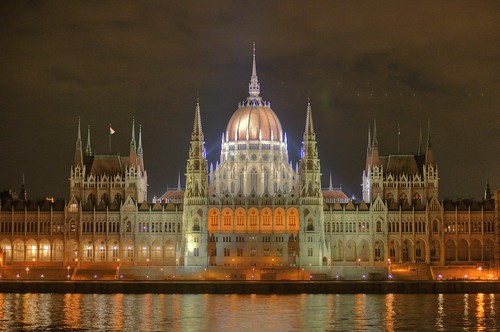
Hungarian Parliament building in Budapest


_MAL3957.jpg, originally uploaded by Michael A. Lowry.

In photography, taking several different exposures of the same scene, each with slightly different settings is called bracketing. in the days of film, photographers often used bracketing when they weren’t certain of the correct exposure or aperture. By bracketing (capturing a few photos with settings in each direction below and above the current settings), a photographer could increase the chances that at least one photo would have the desired exposure, depth-of-field, or whatever else he was looking for. Bracketing is also a useful tool in teaching the art of photography: having several photos of the same scene taken with different apertures, say, helps one to understand the effect the aperture has on the final photograph.

Nowadays, the bracketing feature built into many cameras can be used for some cool new techniques that were not possible a few years ago. With the help of software, it is now possible to combine multiple photographs into a single photo that contains more information than any one of the original images.

Two techniques that fit this description are focus stacking and high dynamic range imaging. Focus stacking involves combining several photos taken with different focal points into one photograph that has a greater depth-of-field than any of its constituent photos. The advantage of this is that the aperture can be left relatively wide. This lets the photographer shoot with shorter shutter times and reduces refraction artifacts often introduced by tiny apertures.

I haven’t yet tried focus stacking. But today I made my first attempt at high dynamic range imaging. The result is the image above.

While in Budapest on business last month, I took a bunch of photos. I haven’t had time to go through most of them yet, but this morning I took a moment to take a look at some of the photos I took of the Hungarian Parliament building across the river from my hotel. I set the camera to take a decent middle-of-the-road exposure. Normally, this photograph would have been quite okay; but it would not have been perfect. The problem with this kind of scene is the big difference in brightness between the darkest and the brightest parts of the image. A photo that properly exposes the brightly illuminated dome would be far too dark to reveal the details of the building’s wings; and a photo with a long enough exposure to capture these details would be blown out in the bright parts.

So I took five of different exposures of the same scene, each with a slightly different shutter speeds: [-2, -1, 0, +1, +2]. I rested the camera on a flat railing and started the exposures using a timer, to ensure that the five photos were of exactly the same scene. The software essentially combined the best-exposed portions of each of the images, resulting in a single image that appears perfectly exposed across the dynamic range. Obviously, the full range of luminosities of the original scene is not represented exactly the same in this image. The original colors have been reassigned to a different palette displayable on standard computer displays, using a technique called tone mapping.

I'm pleased with the result and plan to take more similar photos soon.

2008-04-23

Budapest notes

I'm in Budapest for a week of technical courses related to the Tivoli software I work with in my new role at IBM Software Group. So far, so good. This morning I'm going through a bunch of hands-on labs that show the new features in the most recent releases of IBM's enterprise monitoring tools.

Budapest is beautiful. The weather reminds me of Texas: it was sunny and warm the first day, we had a thunderstorm that night, rain yesterday, and it's hazy and humid today. Last night I joined some Swedish and Norwegian colleagues for dinner at a traditional Hungarian restaurant on the Pest side of the Danube (the hotel is on the Buda side). After dinner, I walked a few blocks to a restaurant/night club where I had read there was supposed to be salsa dancing every Tuesday evening. Unfortunately, I was misinformed. The dancing is only on Fridays and Saturdays. So instead of dancing, I took a long walk along the river and took some photos of famous bridges and buildings. I tried out my D300's bracketing feature for the first time, taking several exposures of exactly the same scene, but with slightly different shutter speeds. I intend to combine the photos in the computer, taking the best-exposed portions of each photo. The result should be a single photograph with "high dynamic range." HDR is a relatively new set of techniques. Do a search on flickr for photos tagged with 'hdr' and you'll get an idea of what's possible. The result can be quite dramatic.

My colleague and friend Warren is here from Austin to give several talks related to IBM's workload automation products. Tonight we plan to find a brewpub and sample some of the local beers. If there's time, I might also take a dip in the Széchenyi fürdő (thermal bath) here. I went to that bath with my good friend Agnès when the two of us traveled around Eastern Europe together nearly sixteen years ago. I remember that the Hungarians had an amazing tolerance for heat. They sat unperturbed on the top bench in a sauna whose lower bench proved too hot for me. I also remember that bath as the place where I was treated to the best massage of my life. Not the sexiest massage, mind you—my masseur was a very large and very brusque Hungarian man. But it was the best massage. Afterward, I felt like a piece of cooked pasta.

I'll return to Stockholm Friday night. Saturday, I'll attend the wedding of my friends Sarah and Thomas. I'll also be tasked with taking photos at the wedding, so I'm excited about that.

2006-07-16

Székesfehérvár


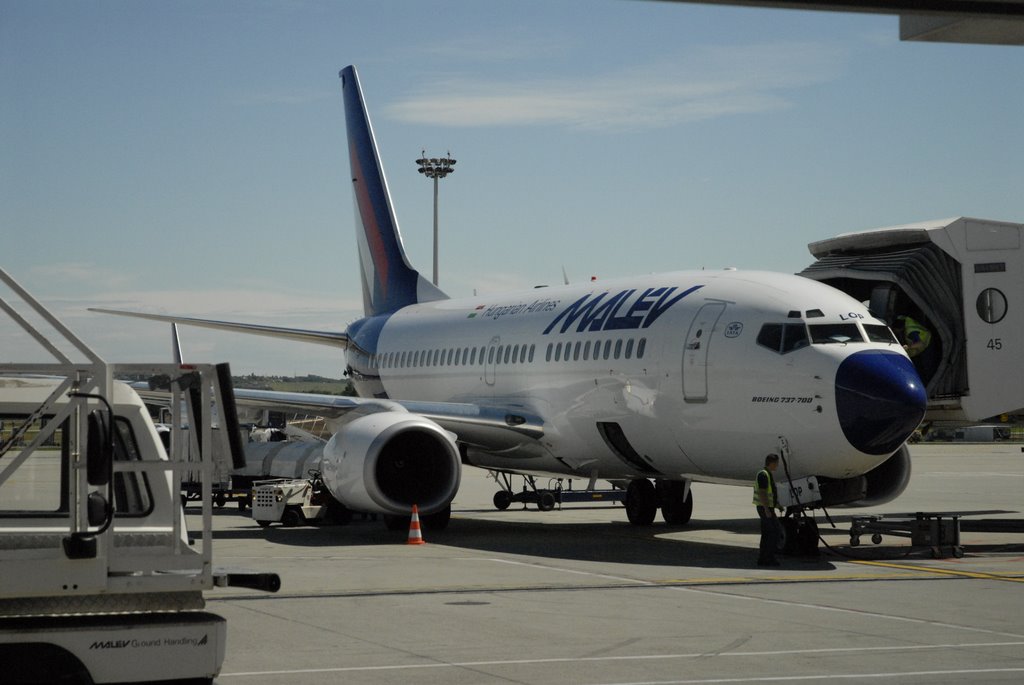
This morning I flew down to Budapest. I'll be in Hungary for a week of consulting work. The flight was smooth and quick. I had a nice chat with a girl on the plane named Annika. She was on her way to Split, where she'll begin a ten-day Croatian vacation with six of her girlfriends.

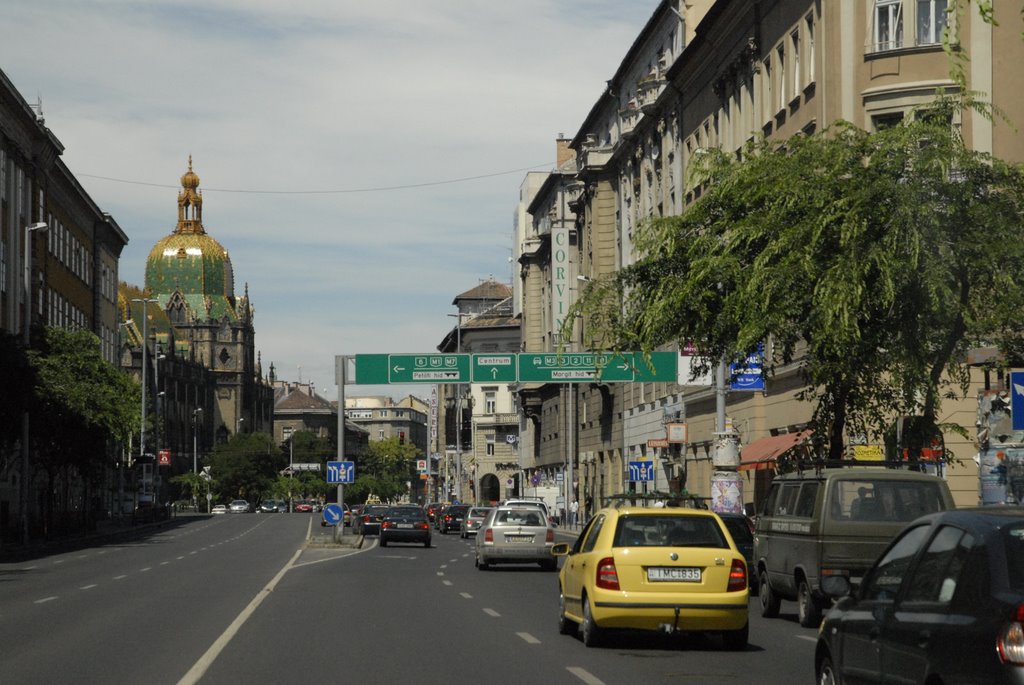
I picked up a rental car at the airport and headed straight for my destination. I won't have time to see the capital on this trip, aside from what I saw of it on my drive through to reach the M7 highway toward Lake Balaton.

I was last in Hungary almost exactly 14 years ago, when I backpacked around Eastern Europe with my good friend Agnes. I had forgotten how picturesque Budapest is. I'll definitely have to return when I have more time to do some sight-seeing. I snapped this shot out the car window while driving West over the Petröfi bridge.

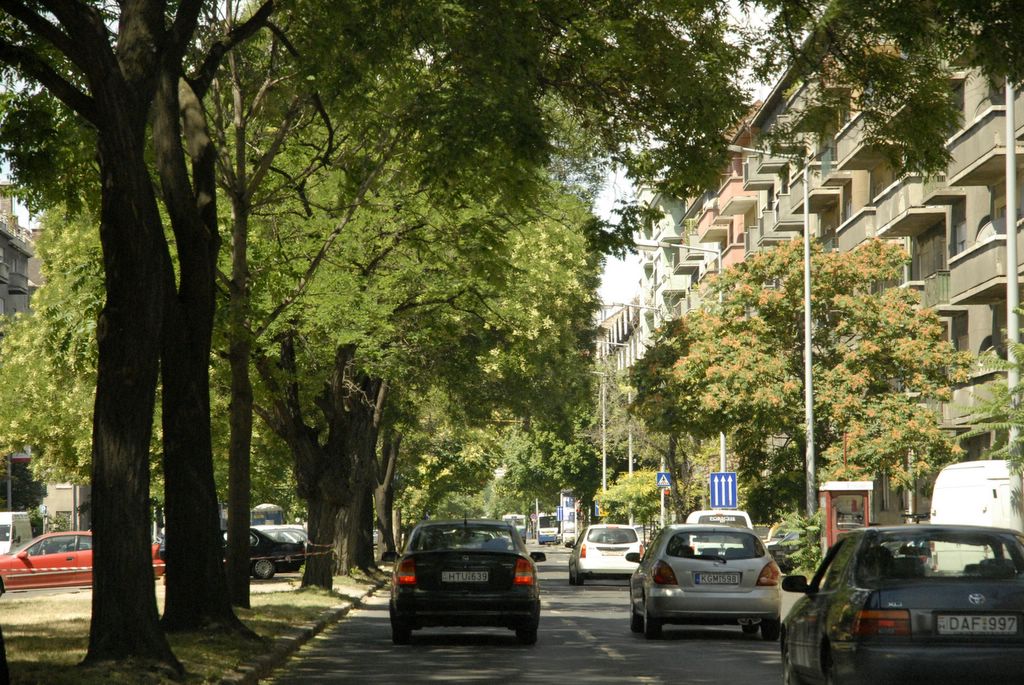
Budapest seems more modern and clean than when I saw it last; one thing is for certain; there are many more new cars, shops, restaurants, and advertisements than there were 14 years ago.
On an unrelated note: Can anyone tell me what possessed me to shoot dozens of photos at ISO 1000 in the middle of the day?

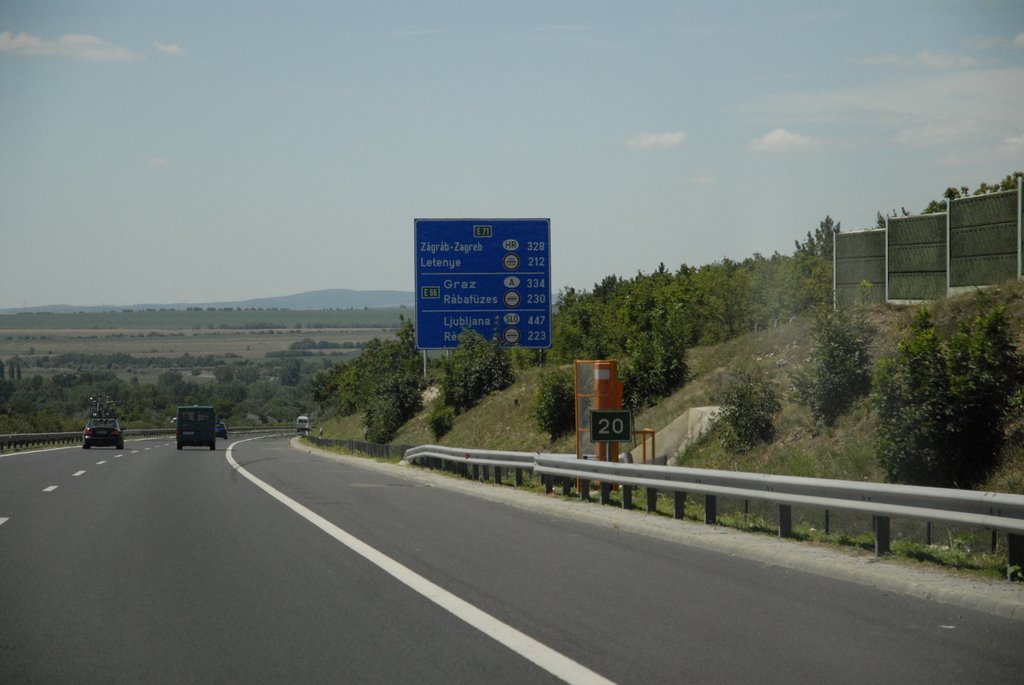
IKEA is everywhere, including on the M7 just Southwest of Budapest.

Hitting the open road. Destination: Székesfehérvár.

It took me a while to find the place, but it's actually hard to miss. IBM's service delivery center in the city is located in the Videoton area, a decaying industrial park on the grounds of what was once a sprawling radio and television factory during the days of socialism. IBM must have chosen this place for the price. Pretty it ain't. IBM's building is quite new though and is very well furnished inside, with good network connections and the latest IP telephones. Neat!

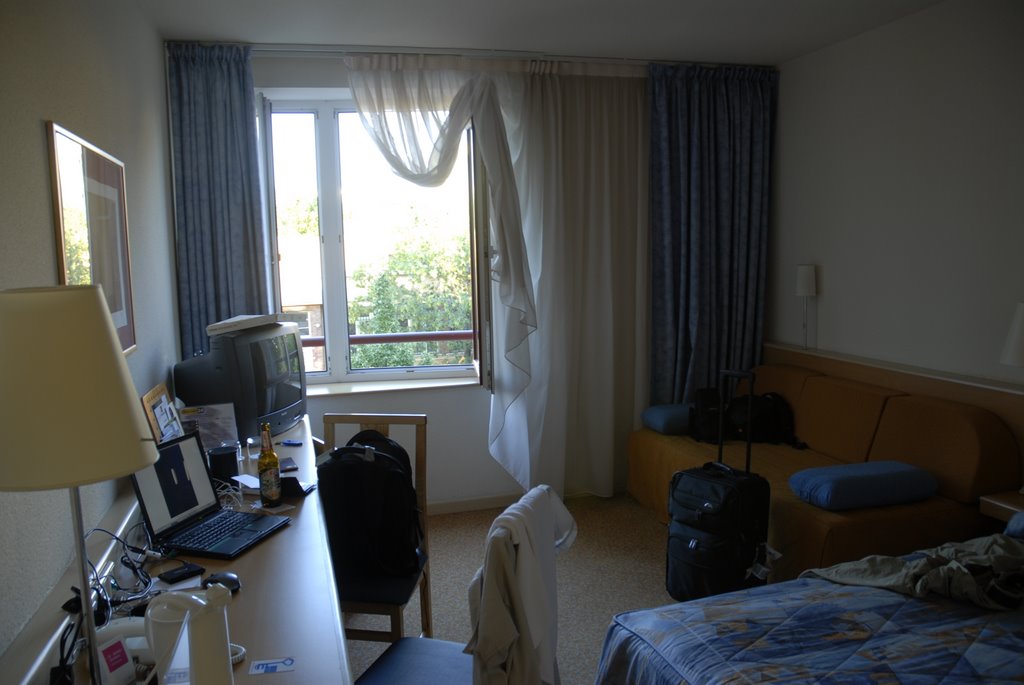
This is my room in the newly renovated and well appointed Novotel Székesfehérvár.

The view outside my window isn't grand, but I've had worse. I spent the afternoon (on a Sunday!) setting up the computers in the classroom at the office, so with that and travelling I was a bit too tired to go out tonight. Tonight, I just sat in the sauna for a while to relax. I hope to see more of the city and sample some authentic Hungarian cuisine later in the week.