2010-04-30

Valborg

Today is Walpurgis Night, or Valborgsmässoafton in Swedish. I will join a bunch of Swedes for a little barbecue down by the lake. It seems like it’s going to be a nice big group—perhaps 50 or 60 people in all, including rowers and other members of the club; students, and also some au pairs. Last year Valborg came and went without a celebration here; so this time I took it upon myself to organize something. There’s also a party at a disco in town later on, but I want to enjoy the day tomorrow, so I think I’ll skip that.

I was at the boathouse last night too. After an excellent and intense bouldering session at Minimum, I went to Nordiska to relax a while in the sauna. It’s just a few minutes away by bus, so it’s very convenient. I think bouldering & sauna will become a tradition for me. After warming up in the sauna, my friends and I ran down to the lake for a quick swim. The water was much warmer than last week. I’d say it was around 15° C last night; last week it was closer to 8° C. As we stood on the dock relaxing and enjoying the reflection of the city lights in the water, the moon began to rise from behind the hills across the lake. It was a dark crimson-orange, a color I have seen it on only one or two other occasions. I wish I had had my tripod with me; it would have been an impressive photo.

Ok, time to wrap up a few more things at the office before leaving for the weekend.

2010-04-28

Will the real Sofia please stand up?

A few years ago, I met a girl—let’s call her Sofia A.—on the free dating site OKCupid. She told me she had studied engineering at Uppsala University in Sweden. She also told me that she was a dual citizen of the U.S. and Sweden because her father was American and her mother Swedish. We began to chat frequently online. I soon learned that she was deaf and had a girlfriend named Hannah. Eventually our conversations became quite personal. However, although she showed me some photos of herself, we never video-chatted, and we never met in person.

Because Sofia already had a partner, she introduced me to her younger sister Lisa, a student at Linköpings University. Lisa and I also began to chat frequently, and although we considered meeting several times, she was also shy, and we never did meet. Eventually, Lisa also told me that she had a new girlfriend, a woman from Japan working at an engineering company in Linköping. Just as with Sofia, Lisa and I never had a video chat and never met in person.

After a year or so of frequent and lengthy chats with both sisters, Sofia informed me that she had gotten a job with a well-known IT firm in California, and would be moving to the San Francisco Bay area. We continued chatting, albeit somewhat less frequently, and she gave intermittent updates about her life there. When I visited my brother in San Francisco, I suggested to Sofia that she and I meet. She declined, and I began to wonder if she was real.

Then, in October of 2008, I moved to Switzerland for work. Soon after moving to Zürich, I joined Nordiska—the Nordic Rowing Club of Zürich—and became acquainted with many Swedes and other Scandinavians here. Among the Swedes I met at Nordiska were several who worked at the Zürich office of the big IT firm where Sofia had started working. When one of these guys told me he was soon going on a trip to the main office in California, I told him about my friend Sofia. “She’s friendly, smart, and Swedish,” I told him. “Look her up and tell her Michael said hello.”

When he returned from his trip, he had disappointing news. “There’s no one with that name working for the company,” he told me. The next time I saw Sofia online, I told her what I had learned. “I use my Mother’s maiden name when chatting online,” she told me. She declined to tell me her real last name. My other friends at the company tried to identify her by her other characteristics—that she was Swedish and deaf, for example. They were also unable to find anyone working there that matched her description.

Then, one day, I saw some photos posted by a friend online. They were photos from a dance competition at La Isla, a salsa dance club in Stockholm that I frequented when I lived there. In the photos, I saw a face that looked familiar. The girl was tagged in the photos, so I clicked through to her profile and looked at her other photos. Those photos looked very familiar. Then it hit me: these were some of the same photos that “Sofia A.” had shared with me years before, and had claimed were photos of her!

Could this be the same girl? Her first name was also Sofia—let’s call herSofia B.—and she appeared to be from Sweden; but judging from the dates and places mentioned in her photos, she had not lived in the U.S.—at least not recently. I sent “Sofia B.” a short note telling her that she looked familiar and asking if we knew each other.

The next day, she replied. She wrote that I didn’t look familiar, but that we had several friends in common. This is true—we both know several people in the salsa dance scene in Stockholm, and I know some of the people who appear with her in the dancing photos. Sofia B.’s email was open and friendly, and did not seem like the kind of reply I would have received from someone who had just been caught in a lie.

I decided to tell her the whole story. I sent Sofia B. another email, explaining why she looked familiar—that I had had a multi-year conversation online with someone who had been using her photos. I pointed her to the profile pages that Sofia A. had created on OKCupid and Facebook.

I received a new reply from Sofia B. She informed me that the photos on the pages I had shown her were old ones, and that all of them had been taken by one man—a former friend of hers, I gather. The impostor is either that man or someone who had access to his photos. She said that she would look into the matter.

I actually know very little about the person I’ve been chatting with all these years. Lying obviously comes naturally to this person, and I simply don’t know what is true and what is made up. The two “sisters” Sofia and Lisa might actually be the same person. In fact, the person might even be a man.

And of course the real Sofia is surely upset to know that someone else has been using her photos to create a false identity. Sofia B. notified OKCupid and Facebook of the fake profiles using her photos. It took a couple of days for them to be removed.

A few days later, the supposed sister of Sofia A., “Lisa,” signed on and said hello. I told her what I had discovered, and explained that I was no longer willing to chat with her unless she was willing to be honest with me. Her reply didn’t really surprise me. “Nice chatting with you all these years,” she said. She made it clear that her anonymity was sacrosanct, and much more important than any friendship we had shared.

I told her that I felt like fool for trusting her. “I’m sorry” was her final reply.

I feel like I’ve lost a friend. I feel betrayed. And most frustratingly of all, I may never know what was real and what was not. I feel a bit like Neo coming out of the Matrix for the first time, waking up to a different reality, and being faced with the prospect of abandoning old friends and old accepted truths. A small part of me feels a desire to retreat to denial and to invent excuses for the liars.

It’s sometimes hard to strike the right balance between openness and caution when dealing with people. I’m usually pretty trusting of people I’ve just met, giving everyone the benefit of the doubt until I have reason to distrust the person. It’s clearly easier however to judge a person’s character when you can see the person face-to-face. Online, it’s easy to hide behind a mask of anonymity. I will definitely be more careful next time.

I’m also realizing that for socializing the ’net is best when it is used as a means to arrange meet-ups in the real world. I have flesh-and-blood friends who are deserving of my time and energy. In the future I won’t be wasting time with phantoms.

2010-04-20

The Böögg goes BOOM!

This afternoon I went downtown to watch the Sechseläuten parade and subsequent bonfire. It was more fun than I expected. After the parade and the burning of the Böögg, I stayed and met up with some friends for a barbecue. We got the help of a man with a long-handled shovel to fetch some coals from the fire, and had a makeshift cookout on the square. Hundreds of other Zürchers were doing the same, and from what I can gather, this has become a time-honored tradition.

2010-04-19

Nordisco, 20 March 2010


_MAL2263, originally uploaded by Michael A. Lowry.

The party at Nordiska a few weeks ago was a great success. Luc, I, and a few others were the last ones at the party when the sun rose around 6.

This morning I finally got around to posting my photos from the evening. Enjoy!

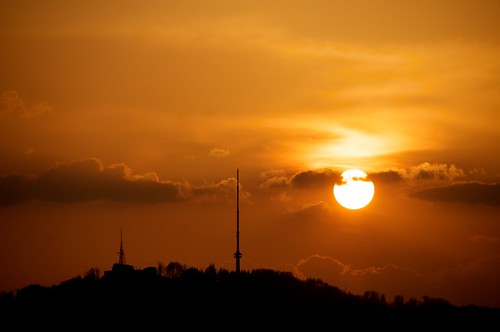
Sunset through the Eyjafjallajökull ash


_MAL3095, originally uploaded by Michael A. Lowry.

Capturing a great photo requires having your camera at the right time and place. Much of the art of photography is arranging to be at the right place at the right time. But yesterday it was just luck. I had been carrying my camera around all day just in case I saw something photo-worthy. Aside from your garden variety holiday snapshots, I didn’t have much success. But then on the walk down Höestrasse to my home, I saw this amazing sunset over Üetliberg. The sky had been covered all day with a sort of soft diffuse silver haze; and at sunset this haze turned a dark shade of yellow—and later, pink. I stood on a handrail and leaned out over the street to capture this photo, zooming in all the way (200mm) and pointing the camera between two houses.

2010-04-15

Be kinder than necessary…

A friend wrote on Facebook this morning: “Be kinder than necessary, for everyone you meet is fighting some kind of battle.” This started a discussion about the challenge of being kind in Sweden, and the differences between Swedes and Americans. I am reposting some of my comments here.

Swedes are careful about letting people get too close, and tend to err on the side of caution when it comes to social situations. If a Swede passes someone on the street she thinks she might know but isn’t sure, she’ll most likely not greet the person. The risk of accidentally greeting a stranger and having to deal the the resulting awkwardness is, for the Swede, too daunting.

The darkness in winter plays an important role. To get a close enough look at the person passing on the street, the Swede will have to practically stare at the passerby. There’s not enough light, and people bundle up so much in winter that their distinguishing features are obscured. Rather than straining to look or make eye contact, most Swedes will just look straight ahead and not even glance at the passerby.

A Spaniard on the other hand, would greet the person, stranger or not—and upon accidentally greeting a stranger, would make a new friend.

It probably also has to do with the relatively high cost of offering hospitality in a cold climate. I.e., if you have to work hard during the warm months just to save up enough food and firewood to last you through the winter, then you’ll naturally be more careful about whom you allow into your circle of friends. But once a person is a friend—well then you’ve gotta stick together no matter what, and help each other through the hard times. It takes longer to make friends in Sweden; but my Swedish friends are people I would count on through thick and thin.

I think it’s clear that many of the social customs we observe today evolved out of necessity, arising naturally from the conditions of the existing physical and social environment.

Whether social customs are well suited to the present environment is largely irrelevant because it can take a long time for customs to catch up with changing conditions.

I like American courteousness and consideration, because it acts as a social lubricant, greasing the gears of everyday social interaction. The waitress at the diner may not actually wonder how you’re doing when she asks, but it’s still a nice gesture—and even smalltalk can offer the opportunity to engage in a real conversation. I also recognize that the American friendliness is often superficial, and that it can be hard to make meaningful friendships with some Americans.

I try to combine the best aspects of both the American and Swedish styles, being friendly to strangers, but devoting most of my energy to those few like-minded friends who have reciprocated my friendship and have shown me that they deserve it.

I think most Swedes would benefit from trying to be a bit more open and friendly with others. And as I have long said, Swedes actually like being friendly. They just need an excuse.

2010-04-01

Martigny, on the way to Chamonix


Martigny, originally uploaded by Michael A. Lowry.
After leaving Martigny, the road climbed steeply into the mountains. We should arrive in Chamonix in half an hour. Greg and I will spend the next four days skiing with friends. There’s a little bit of fresh snow on the ground, so we have reason to hope for good snow conditions. The Swiss-French border is coming up. More to come…

2010-03-26

New look

This morning I used the new Blogger Template Designer to refresh the appearance of the blog a bit. What do you think?

2010-03-03

Vertigo

Last week, I took a couple of days off to go skiing with my friend Therese, who was visiting from Stockholm. We woke up early and took the train from Zürich to Andermatt, the place I went skiing with Swedish friends the winter before I moved to Zürich.

We had a great time skiing Wednesday afternoon, had a beer in the sunshine after the last run of the day, and then relaxed in the sauna for a while before having dinner and retiring for the night. I looked forward to a great full day of skiing on Thursday. Unfortunately, fate stepped in the way of that plan.

When I awoke Thursday morning and began to stretch and roll out of bed, I was hit with a wave of paralyzing dizziness. The world seemed to spin around me, and I could not tell up from down. It felt like being very, very intoxicated—only I was completely sober and had just had a solid night’s sleep.

I couldn’t see clearly, partly because my eyes were still cloudy from a night of sleep, but also because they were not entirely under my control. With each episode of dizziness, my eyes would shudder back and forth involuntarily. Still in the haze of early morning half-wakefulness, I was a bit unsure if I was truly awake, or just having a bad nightmare.

I sat up in bed. I felt sick to my stomach. Was it food poisoning? The dinner the previous night had seemed perfectly fine, and I had slept soundly. So that didn’t seem like a plausible explanation. I turned my head to the window to see a beautiful morning of white snow-covered slopes and bright sunshine. Another wave of dizziness and nausea overtook me, and I broke out in a cold sweat. I was terrified.

I stumbled out of bed and struggled to right myself. I fumbled around, leaning on the wall to remain upright. I managed to make my way to the bathroom, where I stood under the shower to warm up. I felt sick and chilled. The shower helped a bit, but I was still in a state of mild panic.

Thankfully, the scientist in me took charge at this point, and I began to analyze my situation. I realized that the dizziness was associated with motion—specifically, it got worse when I moved my head. I naturally became very slow and careful in my movements, turning my whole body instead of just turning my head, and getting up or sitting down without leaning over. I felt like an old man, moving in such a cautious and deliberate way; but it was working. The dizziness was subsiding, and the nausea and chills were gradually fading away.

I returned to the bed, propped up a few pillows behind my back, and just sat very very still. Therese kindly brought to me some breakfast from the hotel buffet. I managed to eat some cereal and drink some juice and coffee, despite a bit of lingering nausea. The fact that I could eat was a very good sign, I thought. Food poisoning, this was not. A bit of experimentation revealed a crucial detail: the vertigo was triggered when I leaned my head to the left—in other words, when my left ear was facing the ground. I then realized that the nausea and cold sweat were only side effects of the dizziness and panic, respectively.

This was the first time in my life that I had experienced vertigo like this, so its onset had surprised and scared me. Once I realized that the feelings of sickness were merely secondary effects of the dizziness, the situation began to feel less frightening and more manageable. The realization that I could control the dizziness to a degree by limiting my movements made me calmer and more relaxed. I could handle this. I was going to be okay.

With Therese’s help, I got dressed and walked to the doctor in Andermatt. His office was in an old building, and had lovely parquet floors and furnishings. In its appearance, it was was like a doctor’s office from 100 years ago. Visiting the doctor was a very calming and reassuring experience. A very friendly nurse there explained that what I was experiencing was quite common, and was caused by a mechanical problem in the semicircular canals of the inner ear. Apparently, bits of crystalline debris can detach and wander in these canals, causing irregular movement of the fluid whose flow in response to head movements gives us our sense of balance. I later learned that the condition is called benign paroxysmal positional vertigo. The nurse told me that BPPV often goes away after just a couple of days, but that it could last longer, and that in some people, it comes back weeks, months, or years later. The doctor prescribed a couple of medications: one for the dizziness and another for the nausea.

I was feeling a bit unsteady, and still suffering the after-effects of the morning’s exhausting episode; but I felt better and much reassured after visiting to the doctor. On the way back to the hotel, I even felt well enough to go by the post office and mail my application for a new U.S. passport to the embassy in Bern.

Back at the hotel, I ate a bit more, took my medicine, and went back to bed. Therese went skiing, and I slept the whole day. I was mostly ok that evening, and felt even better the next day. By the time we had returned to Zürich on Friday evening, it seemed that the vertigo had almost completely disappeared.

I still experience a brief moment of dizziness occasionally—often when I rouse myself from sleep in the morning. I also sometimes get a faint sensation of my balance being a bit off-kilter; but these are minor nuisances compared to the debilitating dizziness I felt last Thursday. One of my mother’s best friends has a more chronic form of vertigo, and I have a deepened sympathy for her after having experienced a taste of it. I am enormously grateful for my good health!

Update
The Epley maneuver helps alleviate symptoms in many sufferers of BPPV.

2010-02-14

Enjoying the sunshine


Enjoying the sunshine, originally uploaded by Michael A. Lowry.

The weather is absolutely beautiful here at Savognin. We enjoyed a couple of hours of great skiing and then went to the Berhaus Somtgant for lunch. Gotta go now—more skiing awaits!

2010-02-09

Focus stealing

This morning I was steaming milk for a cappuccino when all of a sudden the toaster stole focus. Now my kitchen’s a mess and smells of burned milk. It’s lucky I wasn’t hurt. Just a few years ago, this sort of thing would have been considered completely unacceptable.

When will manufacturers learn that appliances should never steal focus?

2010-01-28

The Apple iPad is the first tablet computer I would actually use


Yesterday, Apple announced its long-rumored tablet computer, the iPad.

This is not first tablet computer; there have been many devices that could fall into that category released over the years. But all of them, including the HP ‘slate PC’ hurriedly rushed to the stage by Microsoft’s Steve Ballmer at CES a few weeks ago, have suffered from the same limitations. These limitations are due in large part to the fact that these tablet computers have been based on PC operating systems. Mac and Windows apps are not designed to be used with a touch-screen; so instead of offering something new and better, tablet PCs have offered something worse—ungainly hybrids that didn’t work as well as the PCs upon which they were based.

Apple took a completely new approach to the tablet computer, and has made obsolete all that came before.

Unlike earlier tablet computers, the iPad does not run a PC OS like Windows or Mac OS X. Instead, the iPad runs a new version of the iPhone OS, an operating system built from the ground up with touch as the primary interface. There is no pointer or cursor; your fingers are the pointers. There are no command key shortcuts; instead, multi-touch gestures provide the vocabulary of human-computer interaction.

Apple is the only significant computer manufacturer that controls the whole widget: the battery, the CPU, the OS, and the core applications—Apple does it all. The results speak for themselves. Watch the iPad video or if you have a bit more time, the video from yesterday’s special event. Microsoft, Amazon, and others will have to work hard to match what Apple has accomplished with the iPad.

I’m convinced that the iPad will shortly become the first popular tablet computer. It will define new standards for touch-based interfaces that will be aped by Microsoft and other imitators.

The iPad is not without problems. There’s no way to add more memory; the 3G version cannot be used as a phone; there is no camera; and the pixel density is anemic for a device meant to be used up close. But these are minor nitpicks. Some of these features were no doubt left out intentionally due to cost or time constraints. Apple doesn’t include a feature until it can be done well. It’s certain that future version of the iPad will address some of the more obvious gaps.

I’m excited about the iPad and look forward to playing with one at the Apple Store on Bahnhofstrasse in a few months. Will I buy one? That remains to be seen. Ultimately, my decision will be based on whether I determine that the device provides a compelling capability that I don't already get from my iPhone 3GS and MacBook Pro.

2010-01-25

Worth noting

Some relationship advice given to a friend recently:

“Bad experiences are part of what make us who we are. If we are strong, we survive them. If we are smart, we learn from them. And if we have enough love in our hearts, we do not let the experiences harden us too much.”

2010-01-12

It certainly does... smart.

First they did it to the word green; now smart gets the same treatment. The marketing & business folks have resorted to using an adjective as a though it were a noun:


I think we can safely assume that the folks who thought this up are not simply ignorant of proper English, but are on the contrary entirely cognizant of their error, and hoping to grab the public’s attention for a time through the deliberately unconventional use of language.

There is a long tradition of this sort of thing. Apple’s Think Different advertising campaign is but one recent example.

It is a bit disheartening, however, to observe the effect this has on the language. It’s hard enough to encourage proper use of the language without advertisers’ abominable abuses to the language competing for people’s attention.

From the point of view of the language, using this type of deliberate error in well-funded ad campaigns can be seen as a short-sighted exploitation of a limited resource. The resource in this case is people’s attention, combined with the limited number of novel mistakes that the language can tolerably absorb.

What slash-and-burn agriculture is to the rain forest, so this type of deliberate misuse is to the language. Both yield short-term results, but also leave lasting damage.

There is a disproportionate influence exerted upon the language by commercial entities whose short-term interests have little to do with the long-term consistency, simplicity and beauty of the language.

I have observed a similar phenomenon when it comes to product names. Every few years, some new MBA will come along and decide to rename everything, under the guise of “establishing coherent brand identity across product families,” or some such thing. This inevitably leads to great confusion among sales and technical staff, to say nothing of the poor customers. Sure, the product lineup gets the shine and sparkle of a new name; but here too the unintended consequences are real and lasting: no one knows what anything is called anymore, and there’s the practical impossibility of finding coherent information about a product whose name has changed four times in the space of a few years.

2010-01-11

Beyond race

Some folks have recently claimed that James Cameron’s Avatar contains racist themes. This is absurd. If anything, the film is about the need to move beyond the self-centered view that any one group of people is special. Cameron wants us to expand the circle to include non-humans. This enlightened viewpoint is the opposite of racism. The race (within the species) of the human characters is largely irrelevant, made to seem all the more insignificant by the larger inter-species conflict between humans and Na’vi.

I do not see see Avatar as the story of a white messiah saving a primitive tribe. On the contrary, it seems clear to me that one of the main points of the film is that that race—and even species—is not what makes people special.

2010-01-10

On the way to the Alps


On the way, originally uploaded by Michael A. Lowry.

I’m joining a couple of colleagues for a day of skiing at Laax, a ski area just 1 ½ hours’ drive from Zürich. The weather is not forecast to be particularly good, but one can always hope that it’s sunnier at the higher elevations. This’ll be my first day on the slopes this winter. I had considered going ski touring today, but opted for good old downhill sking instead because I’m still tired from a long first week back at work. I also did sporty things every day of the week, so I need to do something comparatively relaxing today. I’ll try to post more pix from the mountain!

2010-01-08

Gender identity and ID cards

An article in The Local describes an effort underway in Sweden to offer alternate identity cards to those considering sex-reassignment surgery. The thinking is that those who self-identify as a gender other than their biological gender will be able to present themselves as the person they want to be.

I find this topic fascinating, because it challenges some of our most basic assumptions about what it means to be male or female. People ought to be able to be whoever they want. However, we must also recognize that the presence of people in society who don’t fit into our neat little categories poses some problems.

People like to be able to make assumptions about others. These assumptions save time and offer the illusory comfort that we live in a stable and predictable world. Sometimes though it becomes clear that certain time-honored assumptions are outdated and must be discarded, even at the expense of eliminating this source of comfort and challenging people to abandon their long-held prejudices. Most people today would agree that it is wrong to make assumptions about a person based on the color of her skin. However, it took a long and difficult struggle to get to this point. Along the way, many people were made to feel very uncomfortable, precisely because their assumptions were challenged.

Any time you challenge people’s basic assumptions, you’re going to make them uncomfortable.

One of the most basic assumptions people like to be able to make is that there are only two genders, and that it’s easy to tell who is a man and who is a woman. The presence of transgender people challenges this assumption.

I’ll give one specific example. Imagine a person who is biologically male, but prefers to identify as a woman. Should this person be allowed to share the same public facilities (toilets, changing rooms, etc) as other women? I dare say some erstwhile open minded women might find their open-mindedness challenged upon encountering this situation in real life. And what would be a solution to the problem that would be fair to everyone? I suppose one might suggest that separate facilities for men and women could be outlawed and that the state could enforce unisex facilities. That would eliminate the need to categorize oneself at all, and would be consistent with the trend toward blurring of the boundaries between the sexes. But although fair, that solution too would upset a great number of people, most notably women who like to feel safe in the assumption that their facilities are free of men.

Which assumptions are sacred, and which must be challenged? That’s not an easy question to answer.

2010-01-04

Eagle Scout Stories: my contribution

As a lifetime member of the National Eagle Scout Association, I was recently invited to contribute a short statement about how my experiences in scouting had contributed to my life. Here is the full text of my submission:
Scouting was a very important part of my youth, and I will always look back upon those days with fondness. The discipline and skills I learned in the pursuit of the rank of Eagle have served me well in life, both in my profession and in my personal life. Scouting instilled in me a spirit of adventure that eventually led me to move to Sweden, and later, Switzerland.
I feel it is my duty to acknowledge my disappointment in the BSA’s regrettable decision to exclude gays and atheists from scouting. Scout organizations in other parts of the world do not discriminate on the basis or religion or sexual orientation. It is high time that the BSA take a more enlightened view, and respect the rightful place of all who wish to participate.

It is my sincere hope that the NESA include my contribution in its entirety in the publication, to be entitled Eagle Scout Stories: Tales from the Trails of Scouting’s Highest Rank. The Boy Scouts of America holds that atheists and agnostics are incapable of being good citizens, and that homosexuals are morally crooked and unclean. The BSA’s position is not just controversial; it is indefensible.

2009-12-26

Christmas 2009 in Austin

2009-12-16

U.S. passport renewal

A couple of nights ago, I returned to Zürich after a lovely long weekend in Stockholm. After packing my bag and getting ready for my trip to Austin, I went to Delta’s website, and attempted to check in online. Delta refused to let me check in online because the expiration date of my passport was within 90 days. I checked in at the airport the next morning, and my trip to Austin (via Atlanta) went smoothly. Before leaving Zürich though, I made a comment on Twitter.

Yesterday, the comment drew some replies on Facebook (to which my tweets are automatically copied). A friend explained that Delta was just making sure that people didn’t leave the U.S. without having a valid passport for their return. The website, he said, must not have made a distinction between those traveling from the ’States and those traveling to the ’States. Later, another friend warned me that I might have trouble when I return to Switzerland at the end of the month.

My U.S. passport expires in February, so my original plan was simply to return home to Zürich and apply for a passport via the U.S. embassy in Bern. However, my friend explained that U.S. citizens traveling abroad are often required to have a passport valid for a period of time beyond their stay abroad. The U.S. State Department’s page for Switzerland states that for travelers to Switzerland, “the passport should be valid for at least three months beyond the period of stay.” Some folks are turned away at the airport, my friend told me. Others are refused entry into their destination country once they arrive. Yikes!

I then thought I would just renew my passport while in the U.S. However, the normal renewal by mail takes four to six weeks, and I’m going back to Switzerland at the end of the month. To obtain quicker service, one must pay an extra sixty dollars over the standard renewal fee of seventy-five dollars, and one must submit the form in person at a passport office. The nearest passport office is in Houston, and I didn’t really want to take time away from family and friends just to drive down to Houston for a day.

My friend suggested ABC Passport Express, a company here in Austin that assists with passport applications and renewals. For an additional $195 over the $135 charged by the State Department, ABC Passport will drive down to Houston, submit the paperwork, and return with the new passport. That would mean $330 just to renew my passport a bit quicker. I wondered if there were another way.

I called the State Department and asked if there were any rules that would prevent me from boarding a flight to Switzerland if my U.S. passport were to expire within 90 days. There are no such rules, I was told. I contacted Delta and asked them the same thing. I was told that they didn’t have any policy on the matter, and simply followed the advice of the Travel Security Administration. I then contacted the TSA and asked them the same thing. Once again, I was told that as long as my passport was valid, I would be allowed to travel.

Still, the entry & exit requirements on the State Department’s page caused me a bit of concern. But then I realized: this page states what Switzerland requires of visitors, not what the U.S. requires of departing travelers. My Swedish passport and Swiss residence permit are valid several more years; and because I’ll enter Switzerland using my Swedish passport, I should not have any problems at the border.

Being a dual citizen and a frequent international traveler is at times a bit challenging!