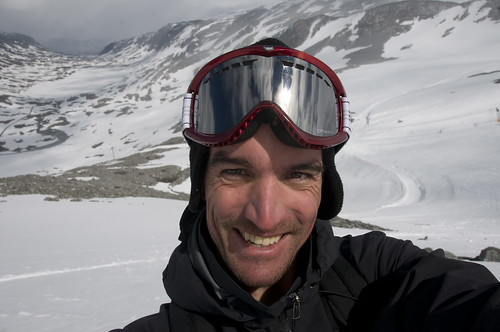
Today was lovely. The sun came out in the morning, and we got a great day of skiing in. I found a slope that's a bit off the beaten path, and it offered more of a challenge, and better snow, than the area served by the lift. You gotta walk up over the ridge after you get off the lift, and that takes ten minutes or so. But it's worth it. I did this slope twice today. here's a photo I took on my last run of the day, with a snowmelt lake in the background.
In the evening after dinner, I took a quick dip in Strynsvatn, the lake beside the cabin where we're staying. It was probably the coldest and quickest swim I've ever taken in my life. Geez, that water's cold. Take a look at the new Stryn photoset I created on flickr to see more photos from recent days, including my hike up to the nearby waterfalls yesterday and my quick swim today.
Tomorrow will be our last day here in Stryn. We'll pack up the cars with all our bags early in the morning after breakfast, and then drive up to the ski area. If the weather looks good, we'll ski part of the day. If not, we'll start driving back to Stockholm already in the morning. In any event, we'll be back in Stockholm soon. It has been a relaxing, exciting, and very enjoyable trip.

2008-06-26
A beautiful day in Stryn


2008-06-24
An afternoon at the bath house
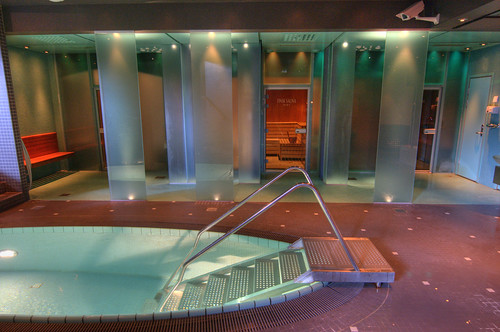
The weather was rainy today, so we drove to Loen and spent a few hours at the Alexandra bath house there. It was lovely, with three different saunas. There were also a few showers with that had programmed combinations of different types of water spray, different scents, and even variations of illumination. More of an experience than a shower, but pretty fun. My favorite was a shower that combined heavy drops, a warm mist, and a eucalyptus fragrance. I gotta get one of those at home!
The bath had a water slide, a big indoor pool, an outdoor pool, and several hot tubs. I spent most of my time alternating between the saunas and the hot tubs, and relaxing on a lounge with a view of the fjord. Here are a few other photos from today.
The photo above is a picture of the sauna & shower area, with the cold pool in the foreground. This mage was created by combining three exposures of slightly different shutter speeds.
We're hoping for sunshine tomorrow so we can go skiing on the glacier again. Good night from Stryn!
2008-06-23
Rainy morning
Summer skiing in Norway
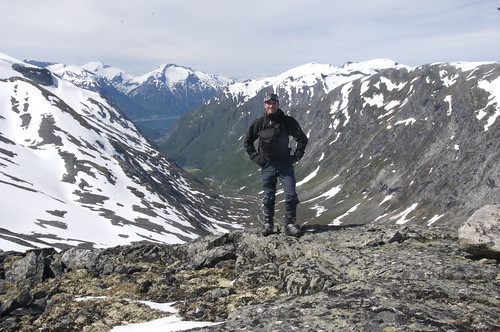
Greetings from Stryn!
Yesterday evening the owners of the Strynsvatn camping site where we're staying built a bonfire on the old pier that juts out into the lake. I walked down to the pier, watched the fire, and struck up a conversation with Magne-Hild, whom I believe is one of the owners. She has lived in this part of Norway all her life. She was born in the little village of Flo, located on the hillside just across the lake and a bit to the Northeast from here. In the days of her youth, the road tunnel through the steep mountain ridges abutting the lake's Eastern edge had not yet been dug, so her village was accessible only by boat. She told me that it was exciting and scary around the time of year when the ice on the lake was too thick for boats, but not thick enough for foot traffic. If someone fell ill and needed a doctor, it required a perilous and uncertain journey. I thought this sounded like the basis for a wonderful story!
Today I did my first summer skiing, on a glacier in the mountains East of here. It was sunny and warm in the morning, and aside from the slushy snow, the skiing was quite okay. The clouds moved in this afternoon, and it's been cool and rainy since then. I managed to get a few good photos while the sun was shining, as well as a lot more in the haze and fog. Here are some photos from today and yesterday.
Tomorrow I think I'll take a break from skiing and go hiking in the mountains South of the here. There's a pass there that's supposed to be about an hour's hike from the water's edge. I'll pack a lunch and head out just after breakfast. With any luck the weather will be nice and I'll get some good photos of the lake from up there.
It's after midnight here (or almost midnight if you go by standard time), and yet the sky outside is not dark. The clouds hanging over the mountaintops are still glowing with the light of dusk-dawn (one and the same at this latitude and at this time of year). There is no night here in the summertime, only a darker twilight. In twenty minutes, it will be at its darkest and will begin to get lighter again.
It's time for me to get some sleep. I'll brush my teeth, crawl up into the top bunk of the bunk bed where I'm sleeping, and nod off for a few hours. Over and out.
2008-06-20
Midsummer's eve in Stryn
2008-06-15
An evening in Zürich
A cloudy afternoon in Zürich
2008-06-09
My first traditional climb
2008-06-04
AT&T-Citibank loses a customer forever
2008-05-30
Bouldering at Kolartorp
2008-05-26
Lindy hop dancing by the lake

The weekend concluded with one more fun coincidence. Almost exactly one year ago, I bumped into fellow Lindy hop dancer Lee on the subway when I was heading home after an afternoon of rock climbing. I ended up tagging along with her to an outdoor pavilion by a little lake near the university, where a gang of folks had assembled to picnic and dance in the evening sunlight.
Well yesterday, the same thing happened again.
On my way back home from the extended brunch, I sat across from a girl who looked quite familiar. After exchanging a few inquisitive glances, I asked her how we knew each other. "Lindy hop," she said. She reminded me of her name, Jenny, and we got to talking. I learned with amusement that she and her friend Jonna were on their way to the same dance place in Stora Skuggan that I'd been two one year before. As I did last year, I decided to tag along.
I saw lots of folks I knew, including Lee, my friend from last year, and Lasse, a fellow photographer who often takes photos of Lindy hop dancing in Stockholm. Jenny's friend Jonna is also a photographer. She had her D80 with her and took a few photos of me while I was dancing. If I manage to get copies of them, I'll post therm here.
A picnic brunch in Rosendals Trädgård
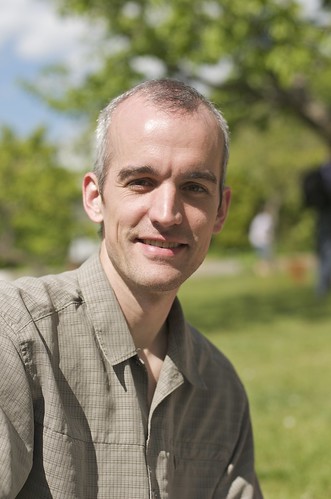
Sunday morning, Janaki joined me at the brunch arranged by my climbing buddy Pete. The last time I went to one of Pete's brunches, there were lots of other rock climbers there. This time, Pete and I were the only two climbers in attendance. I had never been to Rosendals Trädgård before, and I'm really glad I discovered the place. It's just lovely. We bought sandwiches and drinks and ate on the lawn beneath the apple trees in the orchard attached to the nursery. The sun was out, so the place was filled with people. Children ran and played barefoot in the cool grass. At one point, I lay back and put my head on my rolled-up UT Longhorns sweatshirt, dozing off into a half-sleeping, half-meditating state. It was idyllic. This is what I love about Sweden. The summers, when they are good, are almost painfully beautiful. I look forward to more days like this!
Coincidences abound!
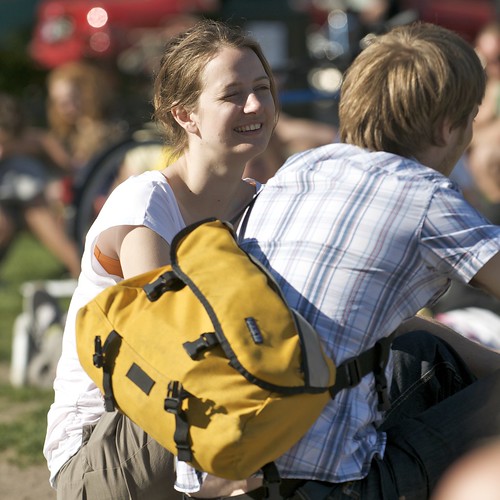
After saying goodbye to Anna, I sat on the grass in the square and soaked up some rays. That's when the weekend's many surprising coincidences began.
First, I ran into Isabelle on the square. I had seen her just the night before, climbing at Klättercentret. She was out for a day-long bachelorette party with the bride-to-be and a bunch of their friends.
A few minutes later, I started a conversation with the owner of an adorable border collie that was running around and playing with a ball. After a moment, she asked me if I danced salsa at Chicago. It turns out we have danced several times at the same place. Her name is Teresa, and even though we have never danced together, she remembered my face (or perhaps the ever-present camera).
Not ten minutes later, as I was taking photos of the random folks on the square, I spotted two more familiar faces. Maria and Johan (pictured above) were sitting beside the fountain at the center of the square. I first met Maria on a trip to Idre Fjäll last winter, and met her again while ice skating a week later. Oddly enough, I also ran into Johan in Andermatt. We bumped into each other in the bar there the night I arrived; he had been there a week and was just winding down before heading back to Sweden.
Sometimes the world is a very small place indeed.
Lunch with Anna
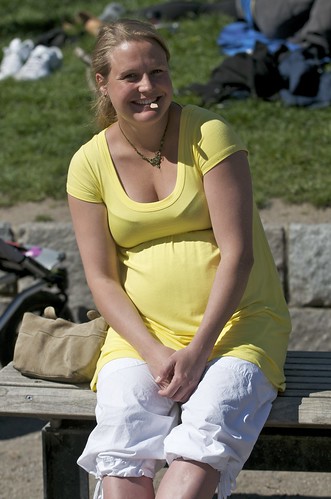
After dancing, I took the subway down to Södermalm and met Anna for lunch. She's almost eight months pregnant, and she looks it! We had pizza at an excellent restaurant on Bondegatan, just a block from Nytorget. It's called Primo Ciao Ciao and they have the best thin pizza I've tasted in Sweden. They make it with fresh ingredients and bake it in a woodfired brick oven. I had the pizza salsicia and a Krusovice dark beer. it was delicious. After lunch, we bought ice cream and ate it on the square. The place was packed with people, due no doubt to the warm sunshine.
Rueda practice
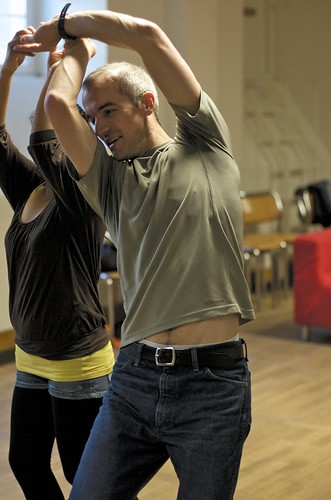
I've joined a group of folks who meet every Saturday morning to practice dancing rueda di casino, a variation of Cuban style salsa in which several couples dance in a circle, switching partners frequently. It's a lot of fun. It's also a great way to learn new salsa moves. I think part of the reason is that we practice one move at a time, over and over again until we have it down pat. Another reason may be that each move has a name. I think this makes it easier to file the move in the brain, somewhat like an index card in a card catalog helps one locate a book in a library.
I think the move I'm doing with Mikaela in this photo is called the carousel.
Oh baby!
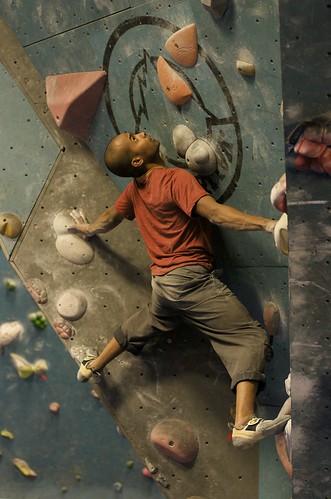
Friday night I joined Isabelle and Patrik for a bit of climbing at KC. I had bouldered there for a few hours the night before, so I didn't expect great accomplishments this night. Even so, I completed a white-graded problem that I'd never seen before. It's probably only the fourth white problem I've completed. Yay!
Here, Karthik climbs a black-graded problem that involves a big leap at the end. Well, it involves a leap for him. I can pretty much do it statically. I think I did well this night because I warmed up properly, starting on the blue and red problems and only proceeding to the black and white ones after the first half hour or so.
2008-05-14
Climbing at Ekoberget on Sunday
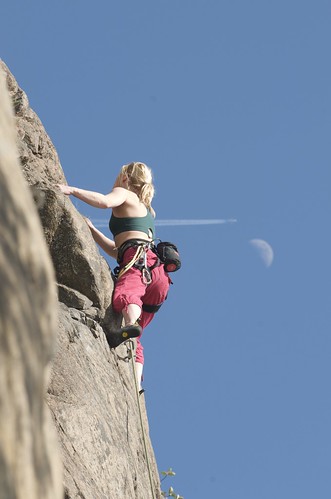
On Sunday I joined Charlotte, Pia & Johanna for an afternoon of climbing at Ekoberget. It was crowded when we arrived around noon, with many of the easier routes already occupied. With some trouble, we managed to set up a top rope on one of the anchors. To do this we walked around to the top, set up an anchor on a tree there, and I rappelled down and traversed up to the anchor. It was scary but we managed. We then tried to climb the crack to the left of the anchor, but it proved too difficult due to the distance of the anchor from the crack. The route under the anchor was fun but at 7b a bit too hard for us. Finally we got to climb a relatively easy 5c. I led it without difficulty and the girls climbed afterward.
There were lots of familiar faces at the cliff, including Sara, shown here climbing a 6c with the moon and an airplane in the sky behind her.
After climbing, I took a dip in the sea beside the cliff. The water was cold, but the warm evening sunlight felt great on my skin once I got out. I'm looking forward to more great outdoor climbing this summer!
2008-05-12
A day in the sun with Linda & friends
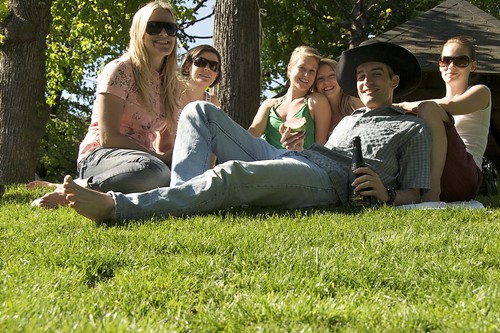
On Saturday, I joined Linda and some of her friends downtown to watch the students' parade. It was funny and silly, with lots of creative and ridiculous floats and themes. Afterward, we walked up to Tegnérlunden where I surprised the girls with a bottle of bubbly and a big slice of watermelon. Reclining on the grass with five beautiful Swedish girls, drinking Cava on the most beautiful day of the year. Could life be any better?
2008-05-05
Sailsalsa pre-party 2008
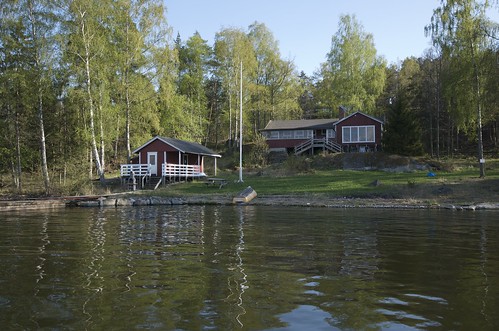
The Sailsalsa 2008 pre-party was this past weekend, and it was a lot of fun. Helena and I met at Bromaplan, where we caught the bus out to Ekerö. At the very end of the bus route we stepped off and walked a few hundred meters to Älghorn, a little piece of land that sticks Northward into Lake Mälaren. It was there at the club house of the Essinge Boating Society that we had the party. Lots of people were there, including Janne, who came all the way up from Copenhagen just for the party (well okay, she had some work to do in Stockholm too).
We played some games outside, including frisbee races around the cabin, and seeing who could stand the longest on a mat of tiny plastic spikes (no big deal!).
Then we grilled our food over a fire down by the lake and ate dinner. After dinner, it was time for dancing. There were a few more women than men this time around so I didn't have much time to rest. We danced until the first light of dawn appeared reflected in the lake outside. We even danced a bit of Lindy hop!
The weather was just lovely, and we spent quite a bit of the time outdoors. When the sun was shining, it was warm enough to sit outside in just a shirt. And even when it wasn’t that warm out, there was always the sauna. Several brave souls warmed up in the sauna and then took a dip in the lake’s cold waters. Refreshing!
When we left to return back to Stockholm on Sunday afternoon, it was with considerable reluctance. After such a lovely weekend, I’m looking forward to Sailsalsa in week 31.
Hungarian Parliament building in Budapest
In photography, taking several different exposures of the same scene, each with slightly different settings is called bracketing. in the days of film, photographers often used bracketing when they weren’t certain of the correct exposure or aperture. By bracketing (capturing a few photos with settings in each direction below and above the current settings), a photographer could increase the chances that at least one photo would have the desired exposure, depth-of-field, or whatever else he was looking for. Bracketing is also a useful tool in teaching the art of photography: having several photos of the same scene taken with different apertures, say, helps one to understand the effect the aperture has on the final photograph.
Nowadays, the bracketing feature built into many cameras can be used for some cool new techniques that were not possible a few years ago. With the help of software, it is now possible to combine multiple photographs into a single photo that contains more information than any one of the original images.
Two techniques that fit this description are focus stacking and high dynamic range imaging. Focus stacking involves combining several photos taken with different focal points into one photograph that has a greater depth-of-field than any of its constituent photos. The advantage of this is that the aperture can be left relatively wide. This lets the photographer shoot with shorter shutter times and reduces refraction artifacts often introduced by tiny apertures.
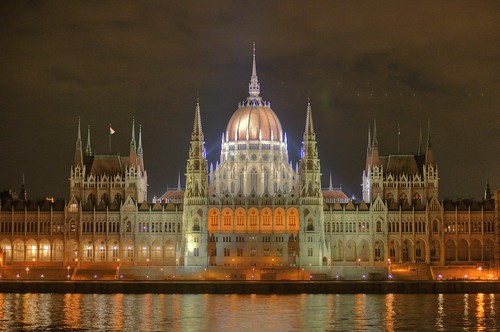
I haven’t yet tried focus stacking. But today I made my first attempt at high dynamic range imaging. The result is the image above.
While in Budapest on business last month, I took a bunch of photos. I haven’t had time to go through most of them yet, but this morning I took a moment to take a look at some of the photos I took of the Hungarian Parliament building across the river from my hotel. I set the camera to take a decent middle-of-the-road exposure. Normally, this photograph would have been quite okay; but it would not have been perfect. The problem with this kind of scene is the big difference in brightness between the darkest and the brightest parts of the image. A photo that properly exposes the brightly illuminated dome would be far too dark to reveal the details of the building’s wings; and a photo with a long enough exposure to capture these details would be blown out in the bright parts.
So I took five of different exposures of the same scene, each with a slightly different shutter speeds: [-2, -1, 0, +1, +2]. I rested the camera on a flat railing and started the exposures using a timer, to ensure that the five photos were of exactly the same scene. The software essentially combined the best-exposed portions of each of the images, resulting in a single image that appears perfectly exposed across the dynamic range. Obviously, the full range of luminosities of the original scene is not represented exactly the same in this image. The original colors have been reassigned to a different palette displayable on standard computer displays, using a technique called tone mapping.
I'm pleased with the result and plan to take more similar photos soon.