
2010-10-20


2010-10-17
Planning for the move
Yesterday morning, I called and booked a moving van for the end of the month. I plan to pick up the truck early the morning of Saturday, 30 October, and to begin at my place in Zollikon around 10 o’clock. With luck we won’t have rain, and the temperature won’t be too cold. I expect that it’ll take a few hours to pack the truck, fifteen minutes to drive to the new place, and a couple more hours to move all the boxes into the new place. I will reward those who help me move with pizza and beer.
I have been living in a furnished apartment for the past two years, so the only piece of furniture I have here in Zürich is a bed. This means I’ll have to buy a lot more furniture before my new place will be livable. After a bit of searching online, I found a dining table that I quite like at mutoni.ch. It’s a large solid oak table in a very modern style. I still need to find chairs that match the table. In addition, I will need to get bookshelves, a couch & coffee table, a desk & office chair, a chest of drawers, a guest bed, and other several smaller pieces of furniture. I will also need to buy a bunch of lights and lamps; most apartments in Switzerland come without any lighting installed.
I have been living in a furnished apartment for the past two years, so the only piece of furniture I have here in Zürich is a bed. This means I’ll have to buy a lot more furniture before my new place will be livable. After a bit of searching online, I found a dining table that I quite like at mutoni.ch. It’s a large solid oak table in a very modern style. I still need to find chairs that match the table. In addition, I will need to get bookshelves, a couch & coffee table, a desk & office chair, a chest of drawers, a guest bed, and other several smaller pieces of furniture. I will also need to buy a bunch of lights and lamps; most apartments in Switzerland come without any lighting installed.
I found out that the IKEA in Dietlikon will be open on Sunday, 31 October. This is a special case; normally most stores are closed on Sundays in Switzerland. It’s perfect for me because that Sunday is the day after I move; and I got a special rate by booking the moving van for the whole weekend. I imagine I can get at least a few of the pieces I need at IKEA.
I love it when a plan comes together.
2010-10-11
Moving to Wollishofen
After two years sharing Gordana & Andrew’s beautiful home in Zollikon, I have made the decision to move to the other side of the lake. It was a difficult decision, but I am confident that it was the correct one.
My new apartment is located in Wollishofen, in a part of the city of Zürich known as Kreis 2. It’s just north of Kilchberg, the neighboring town to the south. The IBM Research lab where I work is located just a bit further south, in Rüschlikon. So I will live about halfway between my workplace and the city. This means I’ll be able to stop by home after work, freshen up or grab a bite to eat, and then head into the city to meet friends. My new place is also just five minutes’ walk from the lake, ten minutes’ bike ride from Nordiska & Minimum, and about fifteen minutes from IBM by bus or bike.
The flat is in the basement of a big old house on a grassy hillside overlooking the lake. It’s on the back side of the house, away from the street and facing the lake. I have my own entrances into the bedroom and living room. The outside door from the living room opens onto a private terrace and a large garden I will share with the other families in the house. There are fruit trees and berry bushes in the garden, and grape vines covering the pergola over the terrace. The place is relatively quiet despite being quite close to the train tracks. The tracks are about a hundred meters away, but down a steep hill and on the other side of a bunch of trees.
The kitchen is tiny, but the dining room and living room are quite big, and have windows facing the lake. There is terra cotta tile throughout the apartment, with floor heating underneath. I’ll have morning sun coming in the window of my bedroom. The house includes a sauna, in the common area just outside my front door. The washer and dryer are also in this shared area, and there is also another shared bathroom there, as well as a bench for lying down and relaxing after a stint in the sauna. This relaxation room has a window and a door leading out into the garden. Big sauna fan that I am, I’m sure I will appreciate this perk—especially in the winter months.
Now I have my work cut out for me. I’ll get the keys on Tuesday the 26th, and will do the big move on Saturday the 30th. Between now and then, I have to pack up all my things, rent a truck, and enlist the help of friends for the move. I will also try to take advantage of the truck to pick up a few pieces of furniture. In my current apartment, I have just one piece of furniture (my bed), so I’ll need to buy all new stuff for the new place: a kitchen table & chairs, bookshelves, a sofa and coffee table, and lots of lights and lamps. Eventually I’ll probably also get a TV and surround-sound audio system. But honestly—I haven’t watched TV in months, and even if I do decide I want a TV, I can always watch on my computer in the meantime. If you’re free on the 30th, and will be in Zürich, please set aside some time to help out with the move. I will offer beer and pizza to all who help!
My new apartment is located in Wollishofen, in a part of the city of Zürich known as Kreis 2. It’s just north of Kilchberg, the neighboring town to the south. The IBM Research lab where I work is located just a bit further south, in Rüschlikon. So I will live about halfway between my workplace and the city. This means I’ll be able to stop by home after work, freshen up or grab a bite to eat, and then head into the city to meet friends. My new place is also just five minutes’ walk from the lake, ten minutes’ bike ride from Nordiska & Minimum, and about fifteen minutes from IBM by bus or bike.
 |
| The view from my the street near my new home; my view is a bit less spectacular, but still pretty good! |
The house is situated about halfway between Wollishofen and Kilchberg train stations. Being a ways from the stations will be a bit inconvenient, but a disadvantage of living nearby a station would be that I would hear the screeching of brakes as the trains pulled in. Where I’ll live, the trains pass quickly by. I will probably buy a car in the next couple of weeks. A car will come in handy during the move, and will make shopping for groceries easier in the future. Plus, I’ve been thinking about getting a car for a while now. I miss having the freedom just to hop in behind the wheel and head out at a moment’s notice. Having a car also means I can take more stuff with me when going skiing, hiking, climbing, and so on.
 |
| The dining room |
 |
| The living room, with the dining room and kitchen beyond |
The kitchen is tiny, but the dining room and living room are quite big, and have windows facing the lake. There is terra cotta tile throughout the apartment, with floor heating underneath. I’ll have morning sun coming in the window of my bedroom. The house includes a sauna, in the common area just outside my front door. The washer and dryer are also in this shared area, and there is also another shared bathroom there, as well as a bench for lying down and relaxing after a stint in the sauna. This relaxation room has a window and a door leading out into the garden. Big sauna fan that I am, I’m sure I will appreciate this perk—especially in the winter months.
 |
| The living room as seen from the bedroom |
2010-09-27
I’m sure it makes perfect sense to Windows folks
From this Microsoft Knowledge Base article, we have the following gem:
- The 32-bit version of the Odbcad32.exe file is located in the %systemdrive%\Windows\SysWoW64 folder.
- The 64-bit version of the Odbcad32.exe file is located in the %systemdrive%\Windows\System32 folder.
It seems the location of operating system programs was not changed when the OS became 64-bit native. So OS binaries stil reside in System32, even though they are 64-bit binaries! SysWoW64 is short for Win32-on-Win64, and is the location of 32-bit binaries on a 64-bit version of Windows.
Why isn’t it like this?
- 32-bit binaries go in System32
- 64-bit binaries go in System64
2010-09-22
An open letter to President Obama
This morning, I received an email from President Obama (sent by way of the Democratic Congressional Campaign Committee). In the email, the president asked me to make a monetary donation to the DCCC to help Democratic candidates campaign for the upcoming mid-term elections.
In the past, I have answered these emails with a donation; but not today. Below, in full, is my response to the president.
In the past, I have answered these emails with a donation; but not today. Below, in full, is my response to the president.
Dear President Obama:
My patience is running thin.
Many times in the past, I have been there when you or the Democratic party needed help, because I believed you would bring fundamental change to our government. However, several of your decisions have diminished my enthusiasm:
1. The bank bail-out helped Wall Street, but did almost nothing for the average American. By propping up the value of toxic assets, you perpetuated the lie of these assets’ outrageously overstated values, merely pushing the problem further down the road. It’s also theft. The government has taken trillions of dollars from future generations of Americans and used the money to prop up the net worth of a bunch of capricious thieves who gambled with other people’s money. Private gains & public losses—an old tune I’m getting tired of.
2. The financial reform measures put in place were watered down so much that they do almost nothing to prevent a repeat of the crisis. Banks will continue to gamble with investor’s money, and to lend out many times what they possess in liquid assets. This is a giveaway to banks, and promotes growth at the expense of stability. The new rules have the appearance of having been written by the banks. This does nothing to allay the impression that some on your financial team are serving their former employers first and the American people second.
3. By failing to put a moratorium on foreclosures, and failing to give judges the authority to adjust the terms of mortgages (reducing the principal and not just the interest), you have turned a blind eye to the plight of millions of families whose home values are now much lower than what they owe on the loans. For these families, it now makes more sense to walk away from their homes than to stay. Foreclosures also have the effect of blighting neighborhoods, further depressing home values and making the problem even harder to solve later.
4. You have not properly acknowledged the human causes of the tragedy in New Orleans. Each time you refer to Katrina as the cause, you repeat a lie. Improperly designed levees and flood-walls led to this catastrophe. It was not a natural disaster. Sure, it’s easier to lay the blame on mother nature than on human incompetence and bureaucratic obstinacy; but it’s wrong. Failure to admit the true causes of this tragedy is a great sin because we also risk a recurrence of the problem if the Army Corps of Engineers is not held responsible for their past mistakes. Even today, the Corps is the body entrusted with evaluating its own performance. This is like letting the fox guard the henhouse.
5. Lastly, I know you are facing problems that you didn’t anticipate. But instead of proposing solutions that had the scale necessary to deal with the problems (the stimulus packages, financial reform, and health care to name just three), you instead brought forth lame compromises and half-measures. Instead of using your bully pulpit to stand up for what's right and shame the opposition into silence, you gave even the most intransigent obstructionists a seat at the table, interminably delaying much needed reforms.
I am gratified to see that you have begun to publicly challenge the opposition to propose better (and workable) solutions. But I wonder if it's not too little, too late. I am also pleased to see that Summers is finally on his way out; on financial matters, you would do well to listen more to the likes of Paul Krugman in the future.
I cannot at present convince myself that a donation to the DCCC would be money well spent. I still have hope for the future. But if you want my financial support, you will have to earn it.
Sincere Regards,
Michael A. LowryI know I am not the only one who feels this way. I hope the president gets the message.
iTunes app update bug
I opened iTunes this morning to see that 5 new app updates were available. Yay!


No updates for you!

FAIL!
I clicked on the Apps category in the left sidebar, and then clicked on the tiny arrow icon at the bottom.
No updates for you!

FAIL!
2010-09-06
The evolution of iTunes from app to store
Some failed to grasp the sarcasm in my previous post. This is inevitable when one engages in satire. The ongoing discussion on iTunes 10’s bland UI led one commentator to write:
From Apple’s point of view, the iTunes/iOS ecosystem has reached a level of market penetration where the focus has shifted away from improving the app and moved more toward exploiting the app’s ubiquity to sell more content.
Since the introduction of the iTunes Music Store, Apple has made each release of iTunes more focused on directing users to stuff they can buy. Here’s just one example: If you click the little gray arrow to the right of an album name, you might expect iTunes to take you to that album in your own music library; but instead, it redirects you to the album in the iTunes Music Store.
Here’s another example: the Ringtones button reappears periodically in bottom row of icons in the iOS iTunes app, and the Podcasts icon disappears. The user can change this, replacing the Ringtones icon with the Podcasts icon; but after a while, it will change back again. Again, this has the effect of directing you toward stuff you can buy (ringtones) instead of stuff that’s free (podcasts).
And one last example: it is not possible to have iTunes save your password for free downloads only. If you want iTunes to save your password, simplifying the downloading of free apps, music tracks, and podcasts, then you must also have a valid credit card on file, and allow iTunes to save your password for purchases too.
Apple’s engineers are well aware that bland, colorless portions of the UI are less likely to capture and hold the interest and attention of the user. This is by design.
From recent updates to the iTunes app, we can infer the following design objectives:
1. Reduce the user interface to its spartan, utilitarian minimum, and focus the user’s attention on the content area of the window;
2. Lead the user quickly to purchasable or promotional content in the Store, and do this from as many places in the app as possible; and
3. Make it as easy as possible to purchase content.
I think the real motivation behind this is to [...] make what you can buy colourful and what you already own bland.He hit the nail on the head.
From Apple’s point of view, the iTunes/iOS ecosystem has reached a level of market penetration where the focus has shifted away from improving the app and moved more toward exploiting the app’s ubiquity to sell more content.
Since the introduction of the iTunes Music Store, Apple has made each release of iTunes more focused on directing users to stuff they can buy. Here’s just one example: If you click the little gray arrow to the right of an album name, you might expect iTunes to take you to that album in your own music library; but instead, it redirects you to the album in the iTunes Music Store.
Here’s another example: the Ringtones button reappears periodically in bottom row of icons in the iOS iTunes app, and the Podcasts icon disappears. The user can change this, replacing the Ringtones icon with the Podcasts icon; but after a while, it will change back again. Again, this has the effect of directing you toward stuff you can buy (ringtones) instead of stuff that’s free (podcasts).
And one last example: it is not possible to have iTunes save your password for free downloads only. If you want iTunes to save your password, simplifying the downloading of free apps, music tracks, and podcasts, then you must also have a valid credit card on file, and allow iTunes to save your password for purchases too.
Apple’s engineers are well aware that bland, colorless portions of the UI are less likely to capture and hold the interest and attention of the user. This is by design.
From recent updates to the iTunes app, we can infer the following design objectives:
1. Reduce the user interface to its spartan, utilitarian minimum, and focus the user’s attention on the content area of the window;
2. Lead the user quickly to purchasable or promotional content in the Store, and do this from as many places in the app as possible; and
3. Make it as easy as possible to purchase content.
2010-09-02
Desaturate now!
 Since Apple released iTunes 10 yesterday, some people with far too much time on their hands have complained about Apple’s decision to remove color from the iTunes user interface. “Grayscale icons are harder to identify than color icons,” they whine, “low contrast icons and UI elements are more difficult to read!”
Humbug!
These complaints are groundless and hysterical. The geniuses at Apple knows what they’re doing. These are the user interface professionals, remember? You know—the same perfectionists who invented the fucking GUI? Apple doesn’t make mistakes when it comes to the user interface of one of the company’s most vital applications! Trust Apple, and update your personal preferences. Color UIs were just a passing fancy, anyway.
I have long wondered when Apple would jump on the desaturation bandwagon. IBM boldly removed color from its UIs years ago. A directive was handed down that all user interfaces were to be harmonized—all across IBM Software Group. Professional graphic artists were brought in to do the meticulous and painstaking work of replacing confusingly colorful UIs with broad swaths of beautiful grayness (and subtle hints of blue). I am glad to see that Apple has finally chosen to embrace IBM’s proven leadership in user interface design.
I have long wondered when Apple would jump on the desaturation bandwagon. IBM boldly removed color from its UIs years ago. A directive was handed down that all user interfaces were to be harmonized—all across IBM Software Group. Professional graphic artists were brought in to do the meticulous and painstaking work of replacing confusingly colorful UIs with broad swaths of beautiful grayness (and subtle hints of blue). I am glad to see that Apple has finally chosen to embrace IBM’s proven leadership in user interface design.
My only small quibble would be that the iTunes 10 user interface still has too much color. I suggest that Apple follow through with what it has started, and complete the job of removing color from the UI. The capacity display for connected iOS devices is one of the worst offenders.


It’s so gaudy and crass, like a cheap toy prize from a gumball machine. All those colors, screaming for attention! They are more likely to distract and confuse users than to help them. Moreover, even if colors do help the user, relying color cues in the user interface amounts to discrimination against those with color vision impairments.

I’m sure you’ll agree that my proposed improvement is much more professional looking, conveying all the necessary information through a subtle yet rich palette of shades of gray.
Keep up the good work, Apple!
Keep up the good work, Apple!
2010-09-01
Proof of identity in the digitial age
I recently contacted my bank in Texas, and requested that they change my billing address. I sent this request in an email via the bank’s secure and authenticated online banking web site. A day later, I received a reply stating that the change-of-address request had to be submitted in writing, and that a fax would suffice.
So a fax, which can easily be forged and can even been sent from a computer, is acceptable as proof that the request comes from me; but an authenticated email, sent via the bank’s own secure online banking system, is not.
This is insane.
So a fax, which can easily be forged and can even been sent from a computer, is acceptable as proof that the request comes from me; but an authenticated email, sent via the bank’s own secure online banking system, is not.
This is insane.
2010-08-29
Adventures in bathing
Yesterday I met Elena for lunch at Nordiska. We fixed pizza and ate on the balcony. I played peek-a-boo with her daughter Sonia. It was cool outside, so I turned on the sauna and after I had said goodbye to my friends, stepped in to warm up a bit. Figuring that no one would be outside on such a cold and rainy day, I went out to jump in the lake wearing just my towel. As long as no one’s around, this isn’t normally a problem. But when I got outside, I saw that there was a big party tent on the lawn behind one of the neighboring rowing clubs, and a wedding ceremony was underway!
I didn’t want to walk all the way back upstairs just to fetch my shorts—I planned to go running in these shorts later in the evening and didn’t want them to be wet. But I didn’t think waltzing down to the end of the dock and skinny-dipping in full view of the wedding guests was a good idea either. So for modesty’s sake, and so as not to disturb the wedding, I walked over to the shore by Seeclub Zürich, and tried to make a shallow dive into the water there. Unfortunately, I didn't get enough lateral momentum, and although my torso made it to the deep water, my legs dragged along the bottom. I felt the top of my left thigh being scraped by something sharp. It happened so fast, and I didn’t feel any pain. But when lake water began flowing into the wound, I realized immediately that I had received more than just a scratch. I walked out of the water to survey the damage. It was not a pretty sight. There was a twenty centimeter gash on the front of my thigh, running straight upward from just above the knee. As I walked up onto the lawn, the blood began to stream out of the wound, branching out into a tree-like pattern as it flowed down the front of my shin and onto my foot.
So then I had the task of walking back to Nordiska with blood running down my leg, covering up with my towel without getting it bloody, and again, without making a scene that would disturb the wedding guests. It was a bit ridiculous.
I tracked blood all through the boathouse as I made my way back upstairs. I located the first aid kit in the changing room and stopped the bleeding with a pressure dressing. The situation was stable at this point, but the wound was not going to stay closed by itself. I knew I’d need to get stitches if I wanted to avoid ending up with a large scar. I walked to Bürkliplatz and took the tram up the hill to Universitätsspital Zürich, where within half an hour I had submitted my paperwork, gotten a fresh tetanus vaccination, and had been wheeled on a gurney to an operating room, where I was getting sewn up by a nice Austrian nurse named Veronica. She was friendly, and seemed glad to have something to do. The hospital wasn’t very busy that day. While she worked, I chatted with her and asked questions about what she was doing. I also took two videos with my iPhone. After cleaning the wound, she injected the site with anesthetic. These injections were the only painful part of the procedure. Once the wound site had been numbed, I felt only pressure—no pain—for the remainder of the procedure.
Veronica told me she was from Vienna, and that she was here on a temporary internship. She said that she liked the hospital and the city very much, and planned to move here permanently. She was cute too, so after I was all patched up I told her I had enjoyed talking with her and wondered if she might want to keep in touch. The look on her face said it all: “Oh god. Must every man I patch up ask me for my number?” He demeanor changed in an instant. What had previously been a talkative and friendly person became an unresponsive automaton, just doing her job. Having previously told me that she was planning to move to Zürich, she declined sharing her contact information on the grounds that she was “going back to Vienna tomorrow.” Um, yeah. Just say no, okay? I imagined what she must have been thinking: “How nice. Here’s a gentleman—making nice conversation and not even hitting on m—nope, there, he did it. He hit on me.” I guess she hasn’t yet learned how to decline advances gracefully. These things take practice—and a fair amount of mental energy. Oh well. She did an excellent job with the sutures, and for a while at least, we had a nice chat. If I’d made a new friend, it would almost have been worth all the trouble!

Pretty!, originally uploaded by Michael A. Lowry.
I was in and out of the hospital in less than an hour. The whole process was remarkably efficient, and the experience made my visits to hospitals in Sweden and the U.S. seem poor and haphazard in hindsight. Of course the Swiss level of service comes at a cost—but luckily I won’t have to pay it out-of-pocket. The hospital visit will be covered by my IBM’s accident insurance. Companies in Switzerland must purchase accident insurance for all full-time employees.
After leaving the hospital, I returned to Nordiska to pick up my things. I fixed a pizza with the leftovers from lunch, and made my way back home. I had planned to go running with Malin, but obviously that wasn’t going to happen. I called her and explained the situation. “If you planned to go running anyway, then there was no point in getting stitches,” she said. OK! I resolved to take it easy and give my cut time to heal. My doctor friend Linda lives and works in my neighborhood. She met me at the tram stop and came by for a while to check up on me—it was very sweet of her indeed. The wound seems to be quite okay. It’s not painful, and in fact the thing I feel the most is the pulling of hairs by the bandage when I move my leg. The doc told me not to exercise using that leg for at least ten days.
My friend Nic had been kind enough to arrange a skiff rowing course for me and some others. A skiff is a one-person rowing boat, and learning to row a skiff requires special training. Since I began to row last year, I had looked forward to the summer when I would have the opportunity to learn to row a skiff. With that skill under my belt, I could row whenever I wanted to—even without a partner. The course was this morning, and obviously I wasn’t able to participate. When I told Nic last night that I wouldn’t make it (and explained why) she told me that it was one of the best excuses she had heard, but that she would want photographic proof of my injury. Hah! If I’m involved, there’s always photographic evidence to be found. Nic agreed to hold a second course for those who missed this one. Thanks, Nic—you’re an angel!
This was my first experience getting stitches. It was interesting and less of a big deal than I had expected. I have since learned that for some minor cuts that might otherwise require stitches, cyanoacrylate (super) glue often works in a pinch. I’ll have to remember to pack a tube of the stuff on my next backpacking trip.
I didn’t want to walk all the way back upstairs just to fetch my shorts—I planned to go running in these shorts later in the evening and didn’t want them to be wet. But I didn’t think waltzing down to the end of the dock and skinny-dipping in full view of the wedding guests was a good idea either. So for modesty’s sake, and so as not to disturb the wedding, I walked over to the shore by Seeclub Zürich, and tried to make a shallow dive into the water there. Unfortunately, I didn't get enough lateral momentum, and although my torso made it to the deep water, my legs dragged along the bottom. I felt the top of my left thigh being scraped by something sharp. It happened so fast, and I didn’t feel any pain. But when lake water began flowing into the wound, I realized immediately that I had received more than just a scratch. I walked out of the water to survey the damage. It was not a pretty sight. There was a twenty centimeter gash on the front of my thigh, running straight upward from just above the knee. As I walked up onto the lawn, the blood began to stream out of the wound, branching out into a tree-like pattern as it flowed down the front of my shin and onto my foot.
So then I had the task of walking back to Nordiska with blood running down my leg, covering up with my towel without getting it bloody, and again, without making a scene that would disturb the wedding guests. It was a bit ridiculous.
I tracked blood all through the boathouse as I made my way back upstairs. I located the first aid kit in the changing room and stopped the bleeding with a pressure dressing. The situation was stable at this point, but the wound was not going to stay closed by itself. I knew I’d need to get stitches if I wanted to avoid ending up with a large scar. I walked to Bürkliplatz and took the tram up the hill to Universitätsspital Zürich, where within half an hour I had submitted my paperwork, gotten a fresh tetanus vaccination, and had been wheeled on a gurney to an operating room, where I was getting sewn up by a nice Austrian nurse named Veronica. She was friendly, and seemed glad to have something to do. The hospital wasn’t very busy that day. While she worked, I chatted with her and asked questions about what she was doing. I also took two videos with my iPhone. After cleaning the wound, she injected the site with anesthetic. These injections were the only painful part of the procedure. Once the wound site had been numbed, I felt only pressure—no pain—for the remainder of the procedure.
Veronica told me she was from Vienna, and that she was here on a temporary internship. She said that she liked the hospital and the city very much, and planned to move here permanently. She was cute too, so after I was all patched up I told her I had enjoyed talking with her and wondered if she might want to keep in touch. The look on her face said it all: “Oh god. Must every man I patch up ask me for my number?” He demeanor changed in an instant. What had previously been a talkative and friendly person became an unresponsive automaton, just doing her job. Having previously told me that she was planning to move to Zürich, she declined sharing her contact information on the grounds that she was “going back to Vienna tomorrow.” Um, yeah. Just say no, okay? I imagined what she must have been thinking: “How nice. Here’s a gentleman—making nice conversation and not even hitting on m—nope, there, he did it. He hit on me.” I guess she hasn’t yet learned how to decline advances gracefully. These things take practice—and a fair amount of mental energy. Oh well. She did an excellent job with the sutures, and for a while at least, we had a nice chat. If I’d made a new friend, it would almost have been worth all the trouble!
Pretty!, originally uploaded by Michael A. Lowry.
I was in and out of the hospital in less than an hour. The whole process was remarkably efficient, and the experience made my visits to hospitals in Sweden and the U.S. seem poor and haphazard in hindsight. Of course the Swiss level of service comes at a cost—but luckily I won’t have to pay it out-of-pocket. The hospital visit will be covered by my IBM’s accident insurance. Companies in Switzerland must purchase accident insurance for all full-time employees.
After leaving the hospital, I returned to Nordiska to pick up my things. I fixed a pizza with the leftovers from lunch, and made my way back home. I had planned to go running with Malin, but obviously that wasn’t going to happen. I called her and explained the situation. “If you planned to go running anyway, then there was no point in getting stitches,” she said. OK! I resolved to take it easy and give my cut time to heal. My doctor friend Linda lives and works in my neighborhood. She met me at the tram stop and came by for a while to check up on me—it was very sweet of her indeed. The wound seems to be quite okay. It’s not painful, and in fact the thing I feel the most is the pulling of hairs by the bandage when I move my leg. The doc told me not to exercise using that leg for at least ten days.
My friend Nic had been kind enough to arrange a skiff rowing course for me and some others. A skiff is a one-person rowing boat, and learning to row a skiff requires special training. Since I began to row last year, I had looked forward to the summer when I would have the opportunity to learn to row a skiff. With that skill under my belt, I could row whenever I wanted to—even without a partner. The course was this morning, and obviously I wasn’t able to participate. When I told Nic last night that I wouldn’t make it (and explained why) she told me that it was one of the best excuses she had heard, but that she would want photographic proof of my injury. Hah! If I’m involved, there’s always photographic evidence to be found. Nic agreed to hold a second course for those who missed this one. Thanks, Nic—you’re an angel!
This was my first experience getting stitches. It was interesting and less of a big deal than I had expected. I have since learned that for some minor cuts that might otherwise require stitches, cyanoacrylate (super) glue often works in a pinch. I’ll have to remember to pack a tube of the stuff on my next backpacking trip.
2010-08-12
Skype cancels plans to charge iPhone users for Skype-to-Skype calls

OK, that didn’t take very long. Late last month, Skype announced that it had cancelled plans to charge iPhone users for the convenience of making Skype-to-Skype calls over the mobile network.
The latest version of Skype for iPhone also adds the ability to remain running in the background. This means that you can sign in to Skype, and then still receive calls while using other apps or when the phone is locked. Very nice!
2010-05-31
Skype on mobile devices
Yesterday, version 2.0.0 of the Skype iPhone app was released. The new version adds the ability to make calls over the 3G mobile telephone network. Mac Rumors and TUAW pointed out that Skype plans to begin charging a monthly fee for this service sometime later this year. When Skype will begin to charge for the service is not clear: the pop-up message that appears in the app indicates August 2010; the Skype page at the App Store indicates the end of 2010.
What is clear is that at some point in the coming months, it will become necessary to pay a monthly fee to Skype if you want to use the iPhone version of Skype to make calls over the mobile phone network. Mind you, this fee does not cover calls to ordinary telephones or mobile phones; for that, you’ll have to pay additional fees. The monthly fee we’re talking about here is just for the privilege of using the Skype iPhone app to make calls—even Skype-to-Skype calls—over the 3G network.
Skype-to-Skype calls made from the iPhone app will continue to be free when made over WiFi networks. Presumably such calls will also be free when made from the Mac or Windows version of Skype.
Convenience fee
What’s really interesting is the way Skype is hoping to earn money here. Skype is not really talking about charging for using the 3G network per se; instead, Skype is talking about charging for that subset of calls made from the Skype iPhone App. Many laptop users get their internet connectivity via the mobile telephone network, using a 3G USB dongle, or a built-in 3G transceiver in their laptop. In many places it’s also possible to connect your iPhone to your Mac or PC, enable tethering, and share the iPhone’s internet connection with your computer. In this way it is possible to make free Skype-to-Skype calls over the 3G network from the Skype application running on your computer. Skype is not talking about charging these Mac & PC users for ordinary Skype-to-Skype calls. However, the exact same calls made from the iPhone will soon require payment of a monthly fee.
Skype seems to be betting that users will gladly pay a fee for the convenience of calling from the iPhone version of the program.
Who must pay for Skype-to-Skype calls?
| Application | Platform | Connection | Cost |
|---|---|---|---|
| Skype | Mac/Windows | LAN | Free |
| Skype | Mac/Windows | Wi-Fi | Free |
| Skype | Mac/Windows | 3G* | Free |
| Skype | Symbian | 3G | Free |
| Skype | Blackberry | 3G | Free |
| Skype | Android | 3G | Free |
| Fring | iPhone | 3G | Free |
| Nimbuzz | iPhone | 3G | Free |
| Skype | iPhone | Wi-Fi | Free |
| Skype | iPhone | 3G | Monthly fee |
* including calls made over a 3G connection provided by a tethered iPhone
This strategy is similar to Apple’s approach to QuickTime Pro upgrades: the user pays for convenience, not additional features.
An argument can be made that it shouldn’t matter what the underlying network is. Each user pays for his or her own network connection, and I think Skype is going to have a challenge on their hands explaining why users should have to pay when a call is made over one network, but not another. After all, Skype doesn’t pay more to handle calls originating from 3G networks. And as mobile networks become faster and more widespread, a growing percentage of users will be doing more of their work on these networks. Users accustomed to making free Skype-to-Skype calls may be reluctant to begin paying just because they have switched networks. Skype is clearly hoping to get users accustomed to paying for Skype-to-Skype calls, and believes that 3G calls in the Skype iPhone app represent a good point at which to begin that process.
Skype on modified iPhones
Some iPhone users have been making calls over the 3G network for more than a year. There exists software that tricks the iPhone into thinking it’s on a Wi-Fi network, even when it’s actually just connected via 3G. There are several programs that accomplish this feat. Some cost money; VoIPover3G is free.
Installing these programs requires jailbreaking the iPhone—essentially removing Apple’s iTunes/App Store lock-in and enabling the installation of applications not approved by Apple. Jailbreaking has often been a complicated affair requiring some technical skill and no small amount of patience. However, the task has recently become much simpler, thanks to the Spirit application. It is likely that the speed and simplicity of the Spirit jailbreak will result in many more users choosing to jailbreak their iPhones.
For the past year or so, Skype on the iPhone has been able to detect when it it running on jailbroken iPhone. The first time a user runs Skype on a modified iPhone, the program displays a warning message stating that Skype is supported only on unmodified iPhones. The program continues to function normally though, happily making Skype-to-Skype calls over the 3G network. Version 2.0.0 of the Skype iPhone app does not noticeably change this.
An unanswered question is whether this will change later in the year.
If Skype is able to detect when it is running on a jailbroken iPhone, is the program also able to detect the presence of MobileSubstrate hacks? These are the small programs that fool the iPhone into thinking a 3G network is actually a Wi-Fi network. When Skype begins charging for the convenience of making Skype-to-Skype calls over 3G from the iPhone app, how will the program work on iPhones with such hacks installed? I can envision several possibilities:
On jailbroken iPhones, or on iPhones with a MobileSubstrate hack installed,
- Skype continues to work as today, warning the user but functioning normally;
- Skype simply refuses to run; or
- Skype runs but detects the presence of the hack, and does not make calls without payment.
It’ll be interesting to watch how this develops.
2010-05-01
Arboretum
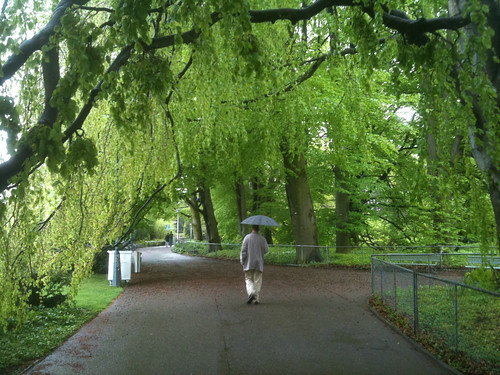
This afternoon I went to Nordiska to tidy up a bit after last night’s fun barbecue. It was rainy and cool out—the rain muffling the noise of an already subdued city. After cleaning, I fixed a bratwurst for lunch, and ate it on the balcony while watching the few sailboats braving the rainy weather on the lake. Then I relaxed a while in the sauna and took a quick dip in the lake. After climbing back out of the water and onto the dock, I stood for a while in the cool rain, just staring out over the water.
I snapped this photo on the walk to the boathouse, in the Arboretum park beside the lake beside the lake.
2010-04-30
Valborg
Today is Walpurgis Night, or Valborgsmässoafton in Swedish. I will join a bunch of Swedes for a little barbecue down by the lake. It seems like it’s going to be a nice big group—perhaps 50 or 60 people in all, including rowers and other members of the club; students, and also some au pairs. Last year Valborg came and went without a celebration here; so this time I took it upon myself to organize something. There’s also a party at a disco in town later on, but I want to enjoy the day tomorrow, so I think I’ll skip that.
I was at the boathouse last night too. After an excellent and intense bouldering session at Minimum, I went to Nordiska to relax a while in the sauna. It’s just a few minutes away by bus, so it’s very convenient. I think bouldering & sauna will become a tradition for me. After warming up in the sauna, my friends and I ran down to the lake for a quick swim. The water was much warmer than last week. I’d say it was around 15° C last night; last week it was closer to 8° C. As we stood on the dock relaxing and enjoying the reflection of the city lights in the water, the moon began to rise from behind the hills across the lake. It was a dark crimson-orange, a color I have seen it on only one or two other occasions. I wish I had had my tripod with me; it would have been an impressive photo.
Ok, time to wrap up a few more things at the office before leaving for the weekend.
2010-04-28
Will the real Sofia please stand up?
A few years ago, I met a girl—let’s call her Sofia A.—on the free dating site OKCupid. She told me she had studied engineering at Uppsala University in Sweden. She also told me that she was a dual citizen of the U.S. and Sweden because her father was American and her mother Swedish. We began to chat frequently online. I soon learned that she was deaf and had a girlfriend named Hannah. Eventually our conversations became quite personal. However, although she showed me some photos of herself, we never video-chatted, and we never met in person.
Because Sofia already had a partner, she introduced me to her younger sister Lisa, a student at Linköpings University. Lisa and I also began to chat frequently, and although we considered meeting several times, she was also shy, and we never did meet. Eventually, Lisa also told me that she had a new girlfriend, a woman from Japan working at an engineering company in Linköping. Just as with Sofia, Lisa and I never had a video chat and never met in person.
After a year or so of frequent and lengthy chats with both sisters, Sofia informed me that she had gotten a job with a well-known IT firm in California, and would be moving to the San Francisco Bay area. We continued chatting, albeit somewhat less frequently, and she gave intermittent updates about her life there. When I visited my brother in San Francisco, I suggested to Sofia that she and I meet. She declined, and I began to wonder if she was real.
Then, in October of 2008, I moved to Switzerland for work. Soon after moving to Zürich, I joined Nordiska—the Nordic Rowing Club of Zürich—and became acquainted with many Swedes and other Scandinavians here. Among the Swedes I met at Nordiska were several who worked at the Zürich office of the big IT firm where Sofia had started working. When one of these guys told me he was soon going on a trip to the main office in California, I told him about my friend Sofia. “She’s friendly, smart, and Swedish,” I told him. “Look her up and tell her Michael said hello.”
When he returned from his trip, he had disappointing news. “There’s no one with that name working for the company,” he told me. The next time I saw Sofia online, I told her what I had learned. “I use my Mother’s maiden name when chatting online,” she told me. She declined to tell me her real last name. My other friends at the company tried to identify her by her other characteristics—that she was Swedish and deaf, for example. They were also unable to find anyone working there that matched her description.
Then, one day, I saw some photos posted by a friend online. They were photos from a dance competition at La Isla, a salsa dance club in Stockholm that I frequented when I lived there. In the photos, I saw a face that looked familiar. The girl was tagged in the photos, so I clicked through to her profile and looked at her other photos. Those photos looked very familiar. Then it hit me: these were some of the same photos that “Sofia A.” had shared with me years before, and had claimed were photos of her!
Could this be the same girl? Her first name was also Sofia—let’s call herSofia B.—and she appeared to be from Sweden; but judging from the dates and places mentioned in her photos, she had not lived in the U.S.—at least not recently. I sent “Sofia B.” a short note telling her that she looked familiar and asking if we knew each other.
The next day, she replied. She wrote that I didn’t look familiar, but that we had several friends in common. This is true—we both know several people in the salsa dance scene in Stockholm, and I know some of the people who appear with her in the dancing photos. Sofia B.’s email was open and friendly, and did not seem like the kind of reply I would have received from someone who had just been caught in a lie.
I decided to tell her the whole story. I sent Sofia B. another email, explaining why she looked familiar—that I had had a multi-year conversation online with someone who had been using her photos. I pointed her to the profile pages that Sofia A. had created on OKCupid and Facebook.
I received a new reply from Sofia B. She informed me that the photos on the pages I had shown her were old ones, and that all of them had been taken by one man—a former friend of hers, I gather. The impostor is either that man or someone who had access to his photos. She said that she would look into the matter.
I actually know very little about the person I’ve been chatting with all these years. Lying obviously comes naturally to this person, and I simply don’t know what is true and what is made up. The two “sisters” Sofia and Lisa might actually be the same person. In fact, the person might even be a man.
And of course the real Sofia is surely upset to know that someone else has been using her photos to create a false identity. Sofia B. notified OKCupid and Facebook of the fake profiles using her photos. It took a couple of days for them to be removed.
A few days later, the supposed sister of Sofia A., “Lisa,” signed on and said hello. I told her what I had discovered, and explained that I was no longer willing to chat with her unless she was willing to be honest with me. Her reply didn’t really surprise me. “Nice chatting with you all these years,” she said. She made it clear that her anonymity was sacrosanct, and much more important than any friendship we had shared.
I told her that I felt like fool for trusting her. “I’m sorry” was her final reply.
I feel like I’ve lost a friend. I feel betrayed. And most frustratingly of all, I may never know what was real and what was not. I feel a bit like Neo coming out of the Matrix for the first time, waking up to a different reality, and being faced with the prospect of abandoning old friends and old accepted truths. A small part of me feels a desire to retreat to denial and to invent excuses for the liars.
It’s sometimes hard to strike the right balance between openness and caution when dealing with people. I’m usually pretty trusting of people I’ve just met, giving everyone the benefit of the doubt until I have reason to distrust the person. It’s clearly easier however to judge a person’s character when you can see the person face-to-face. Online, it’s easy to hide behind a mask of anonymity. I will definitely be more careful next time.
I’m also realizing that for socializing the ’net is best when it is used as a means to arrange meet-ups in the real world. I have flesh-and-blood friends who are deserving of my time and energy. In the future I won’t be wasting time with phantoms.
2010-04-20
The Böögg goes BOOM!
The Böögg goes BOOM!
Originally uploaded by Michael A. Lowry
2010-04-19
Nordisco, 20 March 2010

The party at Nordiska a few weeks ago was a great success. Luc, I, and a few others were the last ones at the party when the sun rose around 6.
This morning I finally got around to posting my photos from the evening. Enjoy!
Sunset through the Eyjafjallajökull ash
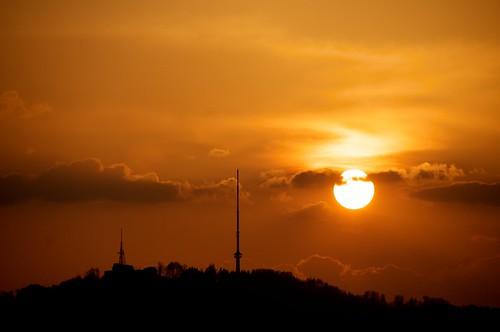
Capturing a great photo requires having your camera at the right time and place. Much of the art of photography is arranging to be at the right place at the right time. But yesterday it was just luck. I had been carrying my camera around all day just in case I saw something photo-worthy. Aside from your garden variety holiday snapshots, I didn’t have much success. But then on the walk down Höestrasse to my home, I saw this amazing sunset over Üetliberg. The sky had been covered all day with a sort of soft diffuse silver haze; and at sunset this haze turned a dark shade of yellow—and later, pink. I stood on a handrail and leaned out over the street to capture this photo, zooming in all the way (200mm) and pointing the camera between two houses.
2010-04-15
Be kinder than necessary…
A friend wrote on Facebook this morning: “Be kinder than necessary, for everyone you meet is fighting some kind of battle.” This started a discussion about the challenge of being kind in Sweden, and the differences between Swedes and Americans. I am reposting some of my comments here.
Swedes are careful about letting people get too close, and tend to err on the side of caution when it comes to social situations. If a Swede passes someone on the street she thinks she might know but isn’t sure, she’ll most likely not greet the person. The risk of accidentally greeting a stranger and having to deal the the resulting awkwardness is, for the Swede, too daunting.
The darkness in winter plays an important role. To get a close enough look at the person passing on the street, the Swede will have to practically stare at the passerby. There’s not enough light, and people bundle up so much in winter that their distinguishing features are obscured. Rather than straining to look or make eye contact, most Swedes will just look straight ahead and not even glance at the passerby.
A Spaniard on the other hand, would greet the person, stranger or not—and upon accidentally greeting a stranger, would make a new friend.
It probably also has to do with the relatively high cost of offering hospitality in a cold climate. I.e., if you have to work hard during the warm months just to save up enough food and firewood to last you through the winter, then you’ll naturally be more careful about whom you allow into your circle of friends. But once a person is a friend—well then you’ve gotta stick together no matter what, and help each other through the hard times. It takes longer to make friends in Sweden; but my Swedish friends are people I would count on through thick and thin.
I think it’s clear that many of the social customs we observe today evolved out of necessity, arising naturally from the conditions of the existing physical and social environment.
Whether social customs are well suited to the present environment is largely irrelevant because it can take a long time for customs to catch up with changing conditions.
I like American courteousness and consideration, because it acts as a social lubricant, greasing the gears of everyday social interaction. The waitress at the diner may not actually wonder how you’re doing when she asks, but it’s still a nice gesture—and even smalltalk can offer the opportunity to engage in a real conversation. I also recognize that the American friendliness is often superficial, and that it can be hard to make meaningful friendships with some Americans.
I try to combine the best aspects of both the American and Swedish styles, being friendly to strangers, but devoting most of my energy to those few like-minded friends who have reciprocated my friendship and have shown me that they deserve it.
I think most Swedes would benefit from trying to be a bit more open and friendly with others. And as I have long said, Swedes actually like being friendly. They just need an excuse.
2010-04-01
Martigny, on the way to Chamonix
After leaving Martigny, the road climbed steeply into the mountains. We should arrive in Chamonix in half an hour. Greg and I will spend the next four days skiing with friends. There’s a little bit of fresh snow on the ground, so we have reason to hope for good snow conditions. The Swiss-French border is coming up. More to come…
Subscribe to:
Posts (Atom)
In the upper radiograph, above, the damaged ligament would appear just above the joint in the center of the photograph. You cannot see it in this picture because soft tissues like muscles, tendons, and ligaments do not show up well in x-ray photos. This is a top-down view, so that ligament lies on the left side of my left index finger. I sustained this injury while working on a particularly difficult bouldering problem at Minimum, back in the beginning of August. It happened when I held a crimpy grip with my left hand and rolled the fingers counterclockwise to give myself a bit more reach to the right. With the weight bearing down sideways on my fingers, the collateral ligaments bore more than their usual share of the load.
Dr. Schweizer gave me some little strips to use to affix my index finger to my middle finger, limiting its mobility, and all but eliminating the possibility of oblique forces that might cause further damage to the ligament. Two months of rest are called for, along with daily exercises to maintain and restore the finger’s range of motion.
I may climb, but only if I completely avoid using my left index finger, or if I tape my index and middle fingers together tightly and avoid sideways loads. The prognosis a full recovery in time.